The URL Shortener Is Dead. Long Live the Link Management Platform.
← Back to Blog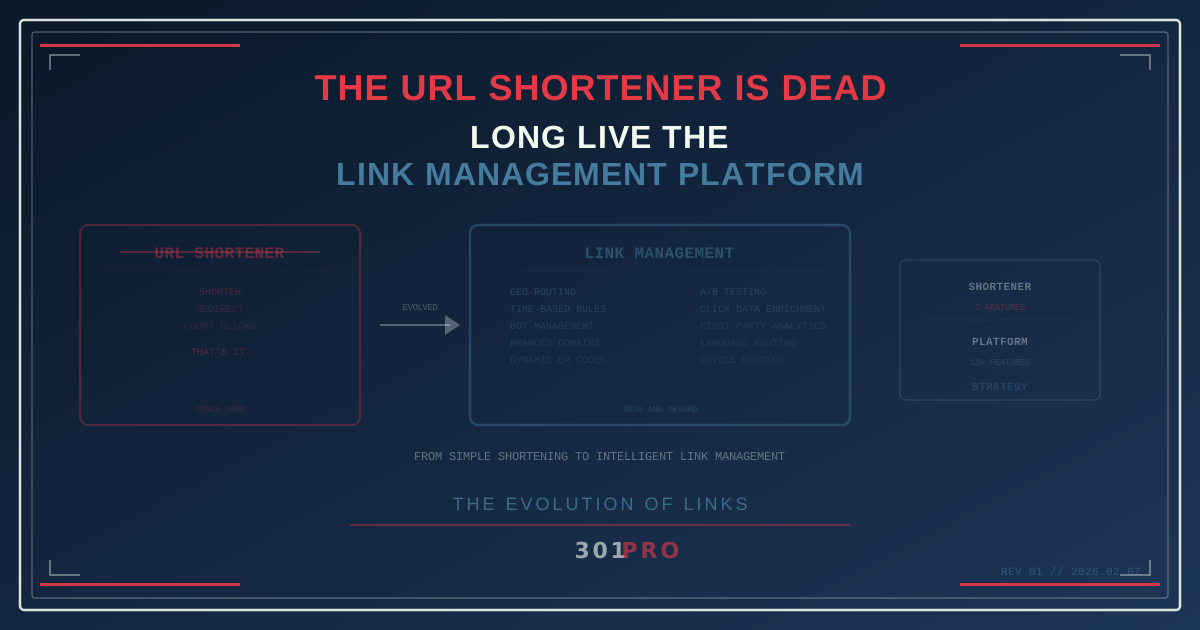
A Solution Looking for Its Old Problem
URL shorteners were invented for a specific reason: Twitter’s 140-character limit. You had a long URL, you needed it shorter, and TinyURL or bit.ly made it fit in a tweet. Problem solved.
That was 2009. Twitter now auto-shortens links. Character limits are mostly a non-issue. The original problem that URL shorteners solved has largely disappeared.
But something interesting happened along the way: marketers realized that links are more than just navigation. They’re data collection points, trust signals, routing mechanisms, and brand assets. The humble URL shortener evolved — or at least, it should have.
The problem is that most URL shorteners didn’t evolve. They still do one thing: make long URLs short. And in 2026, that’s not nearly enough.
What a URL Shortener Does
Let’s be precise about what a basic URL shortener provides:
- Shortening. Takes a long URL, creates a short one.
- Redirect. When someone clicks the short URL, they get redirected to the long one.
- Basic click counting. Total clicks, maybe with timestamps.
That’s it. That’s the entire product. A database lookup that turns click A into redirect B, with a counter.
This was fine when all you needed was a shorter URL. It’s woefully inadequate when your links need to be smart.
What a Link Management Platform Does
A link management platform starts with shortening and redirect — then adds everything else:
Intelligent Routing
Your link doesn’t just redirect to one destination. It evaluates context and routes accordingly:
- Geographic routing: Send users to different destinations based on their location
- Time-based routing: Change destinations automatically on a schedule
- Device routing: Send mobile users to the app store, desktop users to the web
- Language routing: Serve content in the user’s preferred language
- A/B testing: Split traffic between variants to test performance
A URL shortener sends everyone to the same place. A link management platform sends everyone to the right place.
Real Analytics
Basic click counting tells you almost nothing useful. How many of those clicks were bots? Which ones came from mobile? What geography drove the most engagement? What time of day performs best?
301.Pro’s Click Data Enrichment captures the full context of every click — device, location, timing, referrer, and critically, whether the click was from a human or a bot. Analytics you can actually trust, not just a number going up.
Bot Management
This is a capability that URL shorteners don’t even acknowledge exists. Between 30-50% of all link clicks come from bots — link preview generators, security scanners, search crawlers, and malicious bots. A basic shortener counts all of these as clicks and reports inflated numbers.
A link management platform identifies and separates bot traffic from human traffic. Your marketing reports reflect actual human engagement, not machine noise.
Brand Integration
A URL shortener gives you a generic domain: bit.ly/random. A link management platform lets you use your own brand: yourbrand.301.pro/campaign or links.yourbrand.com/offer. As we’ve covered in our posts on branded links, this isn’t cosmetic — it measurably affects click-through rates and trust.
Dynamic QR Codes
A URL shortener generates a QR code that encodes a static redirect. A link management platform generates QR codes backed by dynamic links — the code is permanent, but the destination can change. Print it once, update it forever.
Rules Engine
This is the defining capability that separates a link management platform from a shortener. A rules engine evaluates conditions on every click and routes accordingly. Conditions can include:
- User location (country, state, city, zip code)
- Time of day, day of week, date ranges
- Device type and operating system
- Browser language
- Click count thresholds
- Custom parameters
One link with a rules engine replaces dozens of static short links. Instead of creating a new link for every variation, you create one link with rules that handle all variations.
The Cost of Staying Basic
Using a basic URL shortener in 2026 isn’t just a feature gap — it’s a strategic liability:
Inflated Metrics
If 40% of your clicks are bots and you don’t know it, every marketing decision based on click data is wrong. Your campaign reports are fiction. Your ROI calculations are inflated. Your budget allocations are based on noise.
Missed Routing Opportunities
Every click that goes to a generic destination instead of a localized, personalized one is a missed opportunity. The user in Miami and the user in Seattle see the same page when they could see locally relevant content. That’s not just a technical limitation — it’s a conversion killer.
Brand Erosion
Every bit.ly/random link you share is a brand touchpoint wasted. Your competitors using branded links are building recognition with every click. You’re building recognition for bit.ly.
Vendor Lock-In
Your link shortener holds all your short URLs. If you want to switch, all your existing short links break — every social post, every email, every QR code. A link management platform gives you branded domains you control, reducing dependency on any single vendor.
The Evolution in Practice
Here’s what the shift from URL shortener to link management platform looks like in practice:
| Capability | URL Shortener | Link Management Platform |
|---|---|---|
| Create short links | Yes | Yes |
| Brand the domain | Sometimes | Always |
| Route by location | No | Yes |
| Route by time | No | Yes |
| Route by device | No | Yes |
| A/B test | No | Yes |
| Bot detection | No | Yes |
| Dynamic QR codes | No | Yes |
| Click Data Enrichment | No | Yes |
| Rules engine | No | Yes |
| First-party analytics | No | Yes |
The shortener column has a lot of “No” entries. That’s the point. The capabilities that matter in modern marketing are the ones that basic shorteners don’t provide.
Who Needs What
To be fair, not every use case requires a full link management platform:
URL Shortener Is Fine For:
- Casual personal use
- One-off links with no analytics needs
- Internal notes and bookmarks
- Contexts where branding doesn’t matter
Link Management Platform Is Necessary For:
- Marketing campaigns across any channel
- SMS marketing (trust signals, deliverability)
- QR code campaigns (dynamic destinations)
- Multi-location businesses (geo-routing)
- Any context where you need accurate analytics
- Brand-conscious organizations
- E-commerce and retail promotions
- Creator and affiliate programs
If you’re running a business and sharing links as part of your marketing, you need a platform, not a shortener.
The Industry Shift
The market is moving in this direction whether individual marketers realize it or not:
- SMS carriers are increasingly filtering generic shortener links, favoring branded domains
- Email providers factor link domain reputation into deliverability decisions
- Social platforms evaluate link quality for distribution algorithms
- Privacy regulations are pushing toward first-party data collection, which requires first-party link infrastructure
- AI-powered search cites branded, authoritative sources over generic short links
The infrastructure expectations around links are rising. A basic shortener that was adequate five years ago is increasingly inadequate today.
The Transition
Moving from a URL shortener to a link management platform doesn’t have to be dramatic:
-
Start with new campaigns. Use your link management platform for new campaigns while legacy short links continue working on the old shortener.
-
Prioritize high-visibility channels. Social media, SMS, and email campaigns benefit most from branded links and intelligent routing.
-
Add geo-routing where relevant. If you have multiple locations or regional variations, geo-routing provides immediate value.
-
Enable bot filtering immediately. This is probably the single highest-impact change — your analytics instantly become more accurate.
-
Migrate legacy links gradually. As old campaigns expire, new ones naturally use the platform.
The Bottom Line
The URL shortener was a brilliant solution to a 2009 problem. It made long URLs short. Mission accomplished.
But in 2026, your links need to do more than be short. They need to route intelligently, measure accurately, protect your brand, and adapt to context. They need to be managed, not just shortened.
The URL shortener is dead. The link management platform is what it evolved into. And the difference between the two is the difference between a tool and a strategy.
Your links deserve better than a database lookup with a counter.