Static vs. Dynamic QR Codes: Why Printing a Static Code Is Like Tattooing a URL on Your Arm
← Back to BlogPart of: Dynamic QR Codes
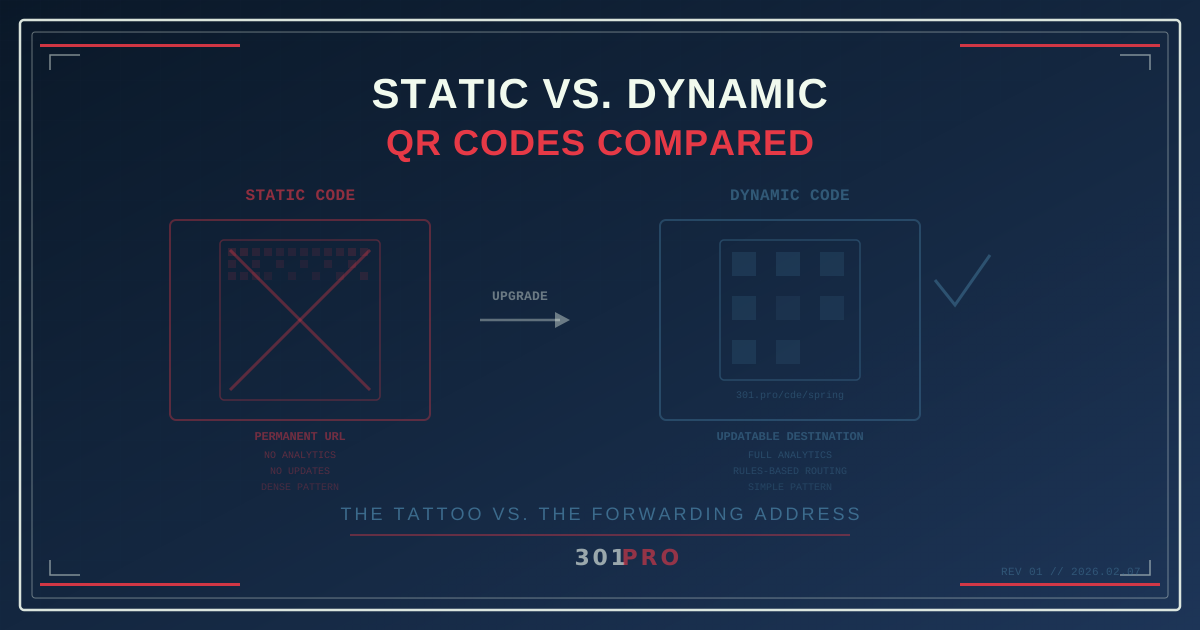
The Tattoo Analogy
Imagine walking into a tattoo parlor and saying: “I’d like you to permanently ink https://www.mybrand.com/campaigns/spring-2026/landing-page?utm_source=print&utm_medium=flyer&utm_campaign=spring26 on my forearm.”
The tattoo artist would look at you funny. “What happens when that page goes away?” they’d ask.
“I guess I’ll just have a dead link on my arm forever.”
That’s exactly what a static QR code is. A URL permanently baked into a pattern of squares. Once it’s printed, it’s done. The destination is frozen in time. If the page moves, the promotion ends, or you realize you spelled the URL wrong — too bad. The QR code doesn’t care. It’s a tattoo.
What “Static” Actually Means
A static QR code encodes a URL directly into the QR pattern itself. Every square in that grid represents a piece of the URL data. The URL is the code. The code is the URL. They’re inseparable.
This means:
- Longer URLs = denser codes. More characters create more modules (the little black squares), making the code harder to scan from distance
- The destination is permanent. Whatever URL you encode at generation time is the URL forever
- No analytics. The QR code is just a visual encoding — there’s nothing tracking scans, devices, locations, or timing
- No updates possible. Printed on 50,000 flyers? If the URL is wrong, you’re reprinting 50,000 flyers
Static QR codes have one thing going for them: simplicity. You generate one from any free tool online, and it works without any service dependency. The QR code itself contains the full URL, so there’s no redirect involved.
But simplicity comes at a steep cost.
What “Dynamic” Actually Means
A dynamic QR code encodes a short redirect URL — like 301.pro/cde/spring — and that redirect points to your actual destination. The QR code doesn’t know or care what the final destination is. It just knows the short link.
This means:
- Short URL = simple code. Fewer characters create fewer modules, making the code scannable from further away and at smaller sizes
- The destination is changeable. Update the redirect, and every printed code in the world now goes to the new page
- Full analytics. Every scan passes through the redirect, so you capture device, location, time, referrer, and more
- Rules engine. Route scans based on time of day, device type, geography, or any condition you define
The QR code on that flyer, poster, billboard, or product package becomes a permanent entry point that you control forever.
The Real-World Difference
Let’s walk through a scenario that happens constantly.
Scenario: Product packaging QR code
You’re launching a new product. Marketing creates a QR code for the packaging that links to a promotional landing page. 200,000 units get manufactured and shipped.
With a static QR code:
| Week | What happens |
|---|---|
| Week 1-4 | Promo landing page works great. 15,000 scans |
| Week 8 | Promotion ends. Marketing takes down the promo page |
| Week 9+ | QR code now leads to a 404 error |
| Forever | 180,000 packages still on shelves scan to a dead page |
With a dynamic QR code (301.Pro):
| Week | What happens |
|---|---|
| Week 1-4 | Promo landing page works great. 15,000 scans tracked with full analytics |
| Week 8 | Promotion ends. You update the redirect to point to the main product page |
| Week 9+ | QR code now leads to the product page. No interruption |
| Month 6 | Holiday season? Route scans to a seasonal promotion |
| Year 2 | New product version? Route to the updated product page |
Same QR code on every package. The destination evolves as your business does.
The Density Problem
Here’s something most people don’t think about until it’s too late: URL length directly affects scannability.
A static QR code encoding this URL:
https://www.yourbrand.com/products/new-widget?utm_source=package&utm_medium=qr&utm_campaign=launch2026Creates a QR code with approximately 130-150 modules per side. From arm’s length, those modules are tiny dots. On a small product package? Nearly impossible to scan reliably.
A dynamic QR code encoding this URL:
301.pro/cde/widgetCreates a QR code with approximately 25-30 modules per side. Each module is 4-5x larger. It scans instantly, even from a distance, even on small labels, even under poor lighting.
This isn’t a minor difference. It’s the difference between a code that works and a code that frustrates your customers.
”But I Don’t Want to Depend on a Service”
This is the most common objection to dynamic QR codes, and it’s a fair one. With a static code, the URL works directly — no middleman. With a dynamic code, you’re routing through a redirect service. What if that service goes down?
Fair concern. Here’s the honest answer:
-
Uptime matters. 301.Pro’s redirect infrastructure is built for enterprise-grade reliability. Your redirect resolves in milliseconds, not seconds.
-
You own the short link. Unlike free URL shorteners that can shut down (remember goo.gl?), 301.Pro gives you links on your own branded domain or on 301.pro, with professional SLAs.
-
The alternative is worse. A static QR code that leads to a dead page is worse than any temporary service hiccup. At least with a dynamic code, you can fix the destination.
The “service dependency” risk of a dynamic QR code is dramatically lower than the “permanent dead link” risk of a static one.
When Static Codes Make Sense (Barely)
To be fair, there are a few edge cases where static codes are defensible:
- Wi-Fi connection codes. The QR code encodes your network name and password directly. No URL involved, no redirect possible.
- Contact cards (vCard). Encoding contact info directly. Though even here, a dynamic link to a digital business card is more flexible.
- One-time personal use. Sharing a link with a friend where analytics and longevity don’t matter.
For any business use case — marketing, packaging, events, print media, signage — dynamic wins every time. It’s not close.
The Analytics Gap
With a static QR code, you know nothing. Literally nothing. You printed 10,000 brochures with a QR code. Did anyone scan it? Which brochure? From where? On what device? At what time?
With 301.Pro’s dynamic QR codes, every scan gives you:
- Device and OS — iPhone vs. Android, which version
- Geography — country, region, city
- Timestamp — when exactly the scan happened
- Bot filtering — 301.Pro’s Intelligent Bot Management separates real human scans from bot traffic, so your numbers are clean
- Scan volume over time — see which placements and campaigns drive engagement
You can correlate scan data with your campaign calendar. “We put up new store signage on March 1st — scans from that location increased 340%.” That’s actionable intelligence you can’t get from a static code.
The Cost Question
Static QR codes are free to generate. Dynamic QR codes require a service. So isn’t static cheaper?
Only if you ignore the cost of:
- Reprinting materials when URLs change (and they always change)
- Lost customers who scan dead codes
- Zero analytics on your most physical marketing touchpoint
- No ability to A/B test destinations
- No seasonal or time-based routing
301.Pro offers a free demo account so you can evaluate dynamic QR codes with real analytics before committing. When you’re ready for production, paid plans start at $149/month — which is a rounding error compared to the cost of reprinting 200,000 packages because you hardcoded the wrong URL.
The Verdict
Static QR codes are tattoos. Dynamic QR codes are forwarding addresses.
One is permanent, inflexible, and ages poorly. The other adapts, reports, and stays useful forever.
If your QR code is going anywhere that it can’t be easily changed — print, packaging, signage, merchandise, TV, anywhere physical — make it dynamic. Use a short link. Get analytics. Keep control.
Your future self, staring at 50,000 packages with a working QR code that points to exactly the right page, will thank you.