Smishing Attacks Are Exploding — How Link Shorteners Are Fighting Back
← Back to Blog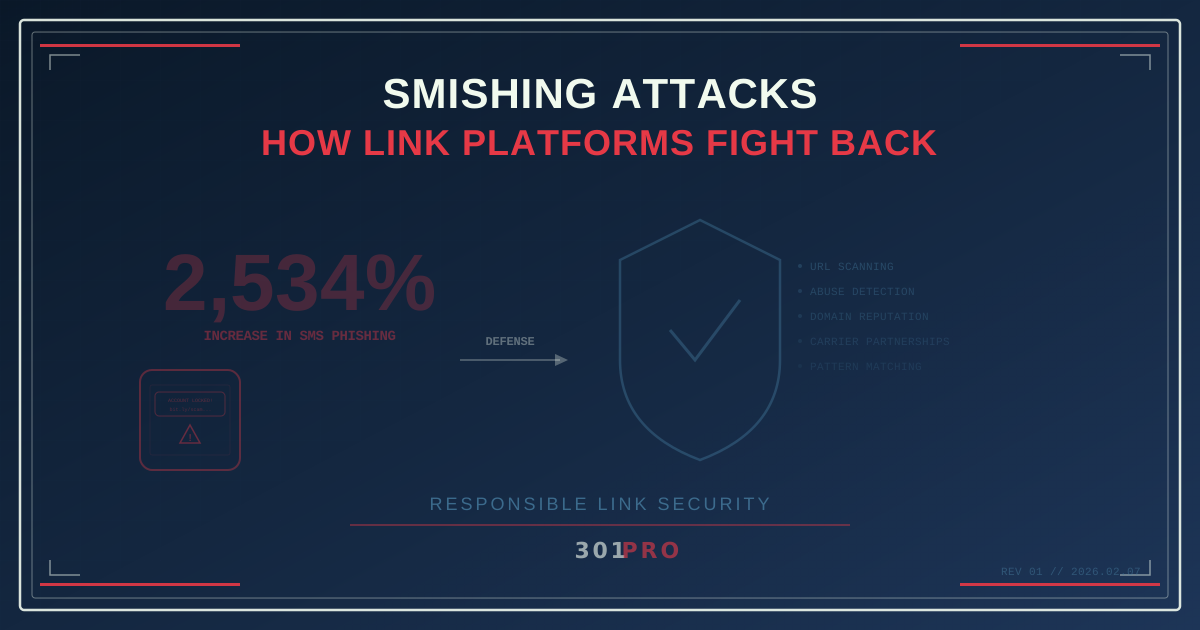
The Smishing Epidemic
Smishing — SMS phishing — went from a niche annoyance to a full-blown epidemic. The growth is steep by any measure: security trackers documented a roughly 2,900% spike in fake-toll smishing texts between 2023 and 2024, and broader smishing volume has risen sharply year over year as attackers shifted to mobile.
The pattern is always the same: you get a text message that looks like it’s from your bank, a delivery service, a toll agency, or the IRS. The message contains a short link. You tap it. You land on a page that looks legitimate. You enter your credentials. Game over.
Attackers love short links for one simple reason: they hide the destination. A URL like bit.ly/3xK9mQ2 or tinyurl.com/y4r7s3pk tells you nothing about where you’re going. The link could point to your bank’s real website or to a pixel-perfect fake hosted on a server in another country. You can’t tell by looking at it.
This creates a trust problem for everyone who uses link shorteners for legitimate purposes.
Why Attackers Target Short Links
Short links are the perfect weapon for SMS phishing because of several properties:
Character Economy
SMS messages have character limits. A full phishing URL might be 80+ characters. A short link is 15-25 characters, leaving plenty of room for the social engineering text that convinces you to click.
Destination Obscurity
Short links are opaque. Unlike a URL where you can see paypal.com or amazon.com in the domain, a short link reveals nothing about the destination. The recipient has to trust the message context to decide whether to click.
Free and Disposable
Most link shorteners offer free link creation with no identity verification. An attacker can generate thousands of short links in minutes, each pointing to a different phishing page. When one gets blocked, they create another.
Redirect Chain Obfuscation
Sophisticated attackers chain multiple shorteners together. A bit.ly link redirects to a tinyurl link, which redirects to a custom domain, which finally lands on the phishing page. Each hop makes it harder for security tools to analyze the final destination.
The Collateral Damage
The smishing epidemic doesn’t just hurt victims — it hurts every legitimate business that uses short links in SMS campaigns.
Carrier filtering is getting aggressive. Mobile carriers use increasingly strict filtering algorithms that flag messages containing short links from known shortener domains. If your marketing SMS uses a generic shortener, there’s a growing chance it never reaches the recipient.
Consumer trust is eroding. People are trained to be suspicious of short links in text messages. Even legitimate messages with short links get ignored because they “look like a scam.”
Domain reputation suffers. When a shared shortener domain (like bit.ly) is used for both legitimate marketing and phishing attacks, the domain’s reputation with security services degrades. This affects deliverability for everyone using that domain.
How Responsible Platforms Fight Back
Not all link shorteners are created equal. Responsible platforms — the ones that take abuse seriously — have invested in multiple layers of defense.
Abuse Detection at Link Creation
The first line of defense is preventing malicious links from being created in the first place:
- URL scanning — when a user creates a short link, the destination URL is checked against known malware and phishing databases
- Pattern matching — flagging link targets that mimic bank, government, or tech company login pages
- Account verification — requiring identity verification for business accounts, making it harder for attackers to operate at scale
- Rate limiting — restricting the number of links that can be created per account per time period
Runtime Destination Monitoring
Links that were clean at creation can become malicious later (the attacker changes the destination after the link is distributed). Responsible platforms continuously monitor:
- Periodic re-scanning of active link destinations
- Click pattern analysis — sudden spikes in clicks from unusual geographic patterns can indicate a phishing campaign in progress
- Destination change detection — alerting when a link’s target is modified, especially to a newly registered domain
Domain Reputation Management
This is where 301.Pro’s approach fundamentally differs from free shorteners:
Free shorteners use shared domains. Every user’s links live on the same domain (bit.ly, tinyurl.com, etc.). One bad actor pollutes the reputation for everyone.
301.Pro supports branded domains and operates its own domain with professional reputation management. Your links either use 301.pro (which is actively monitored and protected against abuse) or your own branded domain. Either way, the domain reputation isn’t diluted by thousands of anonymous users creating unvetted links.
Carrier Relationships
Carrier-level SMS filtering is a major battleground. Carriers maintain lists of domains and patterns that get flagged or blocked. Responsible link platforms maintain active relationships with carriers to:
- Ensure their domains stay off blocklists
- Report abuse proactively
- Provide transparency about their anti-abuse measures
- Support carrier investigation of suspicious traffic
What This Means for Your SMS Campaigns
If you’re sending marketing SMS with short links, the smishing epidemic directly affects you:
Deliverability Risk
Using a free, shared shortener domain in SMS increases the chance your message gets filtered. Carriers can’t easily distinguish your legitimate marketing link from a phishing link when both use the same domain.
The fix: Use a link platform with a managed domain reputation, or use a branded domain for your short links. Both approaches give carriers a cleaner signal that your links are legitimate.
Click-Through Impact
Recipients who are cautious about short links in texts will hesitate to click. The trust gap between “link from a known brand” and “random short link” is widening.
The fix: Where possible, include context that builds trust. “Track your order: [link]” is better than just “[link].” A branded domain (yourcompany.com/go/tracking) is better than a generic shortener.
Compliance Implications
If your SMS links lead through a domain that’s been flagged for phishing — even if your specific link is clean — you could face compliance issues with mobile carrier programs like TCR (The Campaign Registry) and CTIA guidelines.
The fix: Work with a link platform that can demonstrate its anti-abuse practices and maintain clean domain reputation.
The Arms Race
Smishing is an arms race. Attackers get more sophisticated, and defenses have to keep pace.
Current trends:
AI-generated phishing content. The days of obvious “Dear Valued Customer” phishing texts are numbered. AI-generated messages are grammatically perfect, contextually aware, and personalized.
Domain cycling. Attackers register new domains constantly, using each one for hours before it gets flagged. By the time security databases catch up, the domain is abandoned and a new one is active.
Legitimate service abuse. Attackers are using legitimate cloud services and platforms to host phishing pages, making URL-based detection harder.
SMS interception. More sophisticated attacks intercept legitimate SMS messages and modify links in transit, replacing real URLs with phishing URLs.
What You Can Do
Whether you’re a marketer sending SMS campaigns or a security-conscious individual receiving them:
For Marketers
- Don’t use free shorteners for SMS. The shared domain reputation risk isn’t worth the zero-dollar price tag.
- Use a platform with active abuse monitoring. 301.Pro’s Intelligent Bot Management and link monitoring protect both your links and the broader ecosystem.
- Brand your domains. A link from
yourcompany.301.pro/cde/orderis more trustworthy thanbit.ly/3xK9mQ2. - Include clear context. Tell recipients why they’re getting the link and what it does.
- Monitor your campaigns. Unusual click patterns can indicate that your links are being mimicked or your sending numbers are being spoofed.
For Recipients
- Be skeptical of urgency. “Act now or your account will be closed” is almost always a scam.
- Check the sender. Real companies use consistent sender numbers and registered short codes.
- Go directly to the source. Instead of clicking a link in a suspicious text, open your browser and navigate directly to the company’s website.
- Report suspicious texts. Forward suspected smishing messages to 7726 (SPAM) in the U.S. to report them to your carrier.
The Bigger Picture
The smishing epidemic is a tax on the entire SMS ecosystem. Attackers exploit the trust that legitimate businesses have built with their customers through text messaging.
Responsible link platforms have a role to play in this fight. By making it harder for attackers to use short links for phishing, by maintaining clean domain reputations, and by giving legitimate businesses the tools to build trust in their SMS communications, we can push back against the tide.
It’s not a problem that gets solved once. It’s an ongoing commitment to keeping the infrastructure clean. And it’s one of the reasons that choosing a link management platform based solely on “it’s free” is a false economy.