Your Short Link Is Being Scanned by Vulnerability Bots Right Now — Here's What Happens
← Back to Blog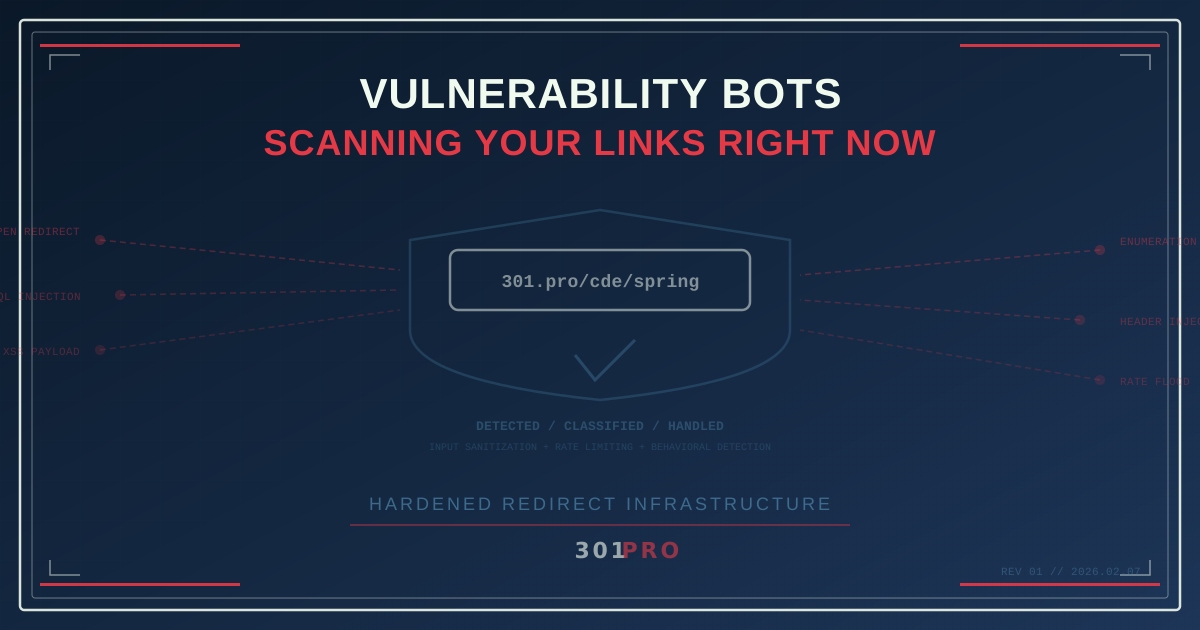
They’re Already Here
Every short link you create gets hit by bots. Not eventually. Not maybe. Right now. Automated vulnerability scanners run continuously across the internet, probing redirect services for security weaknesses. Your link at 301.pro/cde/spring isn’t just being visited by customers — it’s being tested by machines looking for exploits.
This isn’t paranoia. It’s the daily reality of operating on the internet in 2026. Understanding what these bots do, what they’re looking for, and how a responsible link platform handles them is important for anyone who depends on short links for business.
What Vulnerability Bots Are Looking For
Vulnerability scanners are automated tools that probe web services for security holes. When they target short link services, they’re typically testing for:
Open Redirect Exploitation
This is the big one. An “open redirect” vulnerability means the redirect service can be tricked into sending users to any URL — including malicious ones. If an attacker can craft a link like yourshortener.com/redirect?url=phishing-site.com, they’ve found a way to use your shortener’s domain reputation to disguise phishing links.
The attack works because security tools and humans trust the shortener’s domain. A link from 301.pro looks more legitimate than sk3tchy-domain.xyz. If the redirect service blindly forwards to any URL, the attacker essentially borrows the shortener’s credibility.
Parameter Injection
Bots test whether they can inject additional parameters into the redirect URL. Can they append tracking parameters? Can they modify the destination? Can they add JavaScript that executes on the destination page? They probe every angle.
Header Manipulation
Some scanners test whether the redirect service forwards custom headers that could be used for cache poisoning, session fixation, or other header-based attacks. They send requests with unusual headers and observe whether those headers get passed through to the destination.
Enumeration Attacks
Bots try to enumerate all valid short links on a service by systematically trying every possible slug — 301.pro/a, 301.pro/b, 301.pro/aa, and so on. The goal is to discover all active links, their destinations, and potentially sensitive information about a company’s campaigns.
Rate Limit Testing
Scanners probe how quickly they can make requests before being throttled or blocked. If there’s no rate limiting, they can scrape the entire service or launch denial-of-service attacks that affect all users.
The Anatomy of a Bot Scan
Let’s walk through what happens when a vulnerability bot hits a 301.Pro link. We’ll use a fictional scan from a typical automated scanner:
09:14:02 — Initial Probe
The bot makes a standard GET request to 301.pro/cde/spring. It’s checking if the link exists and observing the redirect behavior. What status code comes back? What headers are in the response? Where does it redirect to?
301.Pro’s response: Returns a standard 301 redirect to the configured destination. Nothing unusual, nothing exploitable. The bot gets the same response a human would.
09:14:02.3 — Open Redirect Test
The bot tries 301.pro/cde/spring?redirect=https://evil-site.com and variations. It’s testing whether it can override the destination.
301.Pro’s response: Ignores the parameter. The redirect goes to the configured destination regardless of any URL parameters the bot appends. The link’s destination is stored server-side and can only be changed through the authenticated dashboard. There’s no client-side override mechanism.
09:14:02.5 — Injection Tests
The bot sends requests with SQL injection patterns in the slug (301.pro/cde/spring' OR 1=1--) and XSS payloads in headers and parameters.
301.Pro’s response: Input sanitization at the edge layer strips these before they reach any backend system. The request is logged, classified as malicious, and the source IP is flagged for rate limiting.
09:14:03 — Enumeration Attempt
The bot starts cycling through slugs: 301.pro/cde/a, 301.pro/cde/b, 301.pro/cde/c…
301.Pro’s response: Rate limiting kicks in. After a threshold of requests per second from a single source, responses are throttled. The enumeration attempt captures a handful of links at most before being effectively blocked.
09:14:15 — Rate Limit Escalation
The bot detects throttling and switches to a distributed attack from multiple IP addresses.
301.Pro’s response: Behavioral pattern detection identifies the distributed enumeration attempt based on request characteristics beyond just the source IP. The entire scan pattern gets flagged and managed.
09:14:20 — Bot Gives Up
The scanner moves on to easier targets. This is the typical outcome — vulnerability bots are opportunistic. If the first few probes don’t find weaknesses, they move on. There are millions of other services to scan.
Why This Matters for Your Business
You might think: “I’m just using short links for marketing. Why do I care about vulnerability scanning?”
Three reasons:
1. Your Brand Is on the Line
If a vulnerability scanner finds an open redirect in your link service and reports it (or worse, an attacker exploits it), your short links can be used to disguise phishing attacks. Your company name is now associated with a security incident. “Company X’s link shortener was used in phishing campaign” is not the headline you want.
2. Your Analytics Get Contaminated
Vulnerability scans generate requests that look like clicks. If your link platform doesn’t filter these out, every scan shows up in your analytics as engagement. A sustained scanning campaign can meaningfully inflate your click counts.
3. Service Availability
Aggressive scanning can impact link redirect performance if the platform isn’t built to handle it. If bots are consuming server resources, your real users experience slower redirects.
Free Shorteners vs. Professional Platforms
This is one of the starkest differences between free link shorteners and professional platforms like 301.Pro:
Free shorteners are high-value targets for vulnerability scanners because:
- They allow anyone to create links with no verification
- Their shared domains are widely used and widely trusted
- They often have minimal security infrastructure beyond basic rate limiting
- Vulnerabilities affect millions of users at once
301.Pro is built as enterprise-grade infrastructure:
- Links are created by authenticated users only
- The redirect layer is a hardened, purpose-built system — not a general-purpose web application
- Bot traffic is identified, classified, and handled separately from human traffic
- Security scanning activity is monitored and doesn’t contaminate analytics
- The platform is designed to handle traffic spikes without performance degradation
What You Should Look For
If you’re evaluating link management platforms, ask about security:
Redirect isolation. Can the destination be overridden by URL parameters, headers, or any client-side mechanism? (Answer should be: no.)
Input sanitization. How are slugs, parameters, and headers handled? Is there injection protection at the edge?
Rate limiting. What happens when a bot starts making hundreds of requests per second? Is there per-IP and behavioral rate limiting?
Enumeration protection. Can a bot systematically discover all active links? Are there protections against slug enumeration?
Bot classification in analytics. Are vulnerability scans counted as clicks, or are they separated? Can you see bot traffic without it contaminating your campaign metrics?
Uptime under load. What happens during a scanning campaign? Does redirect performance degrade for real users?
The Ongoing Reality
Vulnerability scanning isn’t a one-time event. It’s a continuous, ongoing reality for every service on the internet. Your short links are being probed right now, and they’ll be probed tomorrow, and next week, and next year.
The question isn’t whether bots are scanning your links. The question is whether your link platform is built to handle it — silently, securely, and without affecting your real users or your real data.
That’s not a nice-to-have feature on a checklist. It’s the baseline expectation for infrastructure you depend on.