Political Campaign Link Strategy: Routing Voters to Their District Resources
← Back to Blog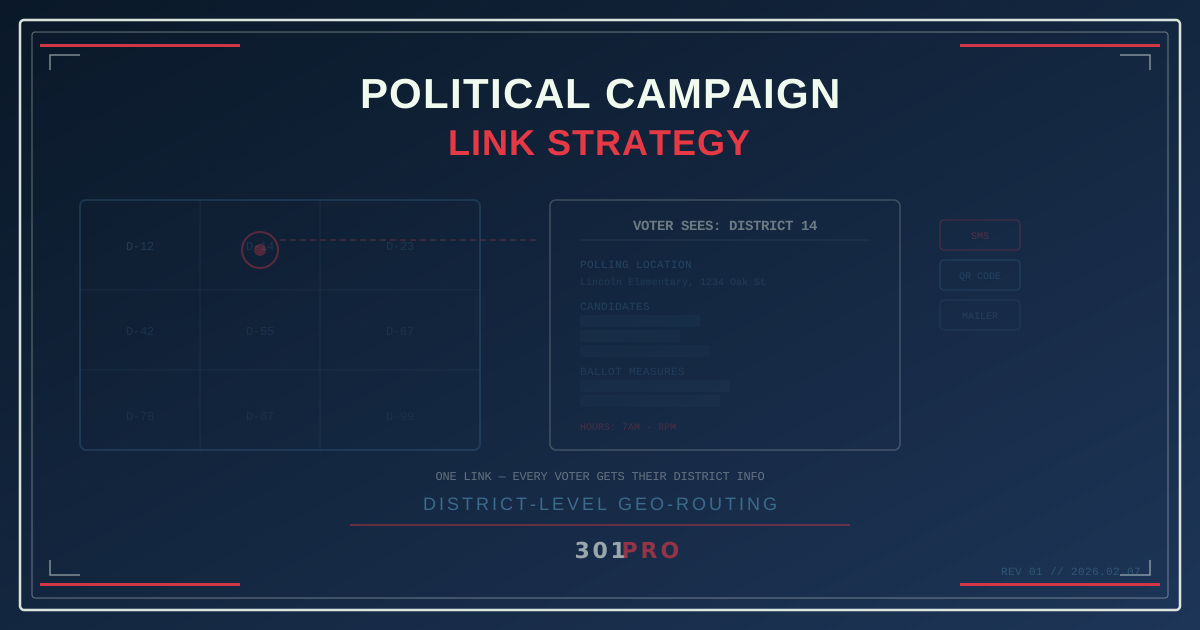
The District Problem
A statewide political campaign sends out 2 million text messages. The message is the same: “Find your polling location and learn about your local candidates.”
The problem? There are 120 state house districts, 40 senate districts, and hundreds of precincts. The voter in District 12 needs completely different information than the voter in District 87. Different polling locations, different candidates, different ballot measures.
The old approach: link to a generic website and make voters search for their district. Most don’t. The text gets ignored. The campaign spent money on 2 million messages that produced minimal engagement.
The modern approach: one link that automatically routes each voter to their district-specific landing page based on their GPS location. No searching. No guessing. Tap the link, see your local information.
Why Political Campaigns Need Geo-Routing
Political campaigns are inherently geographic. Every aspect of the voter experience is location-dependent:
- Polling locations vary by precinct
- Candidates vary by district
- Ballot measures vary by county, city, and special district
- Early voting schedules vary by state and county
- Voter registration requirements vary by state
- Language access requirements vary by jurisdiction
A national or statewide campaign that uses one link for all these variations is asking voters to do work that technology can handle automatically. And in campaigns, every bit of friction costs votes.
The Campaign Link Architecture
Here’s how a well-structured campaign uses 301.Pro’s geo-routing:
The Core Links
| Campaign Link | Routes Based On | Destination |
|---|---|---|
campaign.301.pro/cde/vote | GPS/IP location | District-specific voting info |
campaign.301.pro/cde/register | State | State voter registration portal |
campaign.301.pro/cde/volunteer | GPS location | Nearest campaign office |
campaign.301.pro/cde/donate | No routing needed | Central donation page |
campaign.301.pro/cde/events | GPS location | Local events calendar |
Each link serves a different purpose, but they all share the same principle: one URL that intelligently routes based on where the voter is.
District-Level Routing
The most powerful application is district-level routing. For a state legislative campaign:
- Map every district to a geographic boundary
- Create landing pages for each district with local candidates, issues, and polling information
- Set up geo-rules in 301.Pro that route clicks from each geographic area to the corresponding district page
- Deploy one link across all campaign communications
When a voter in the 14th District taps the link, they see their candidates, their ballot measures, their polling location. When a voter in the 42nd District taps the same link, they see entirely different content — all automatically.
The SMS Campaign
SMS is the highest-engagement channel for political campaigns, and it’s where geo-routing pays off most dramatically.
The Problem with Generic SMS
A generic campaign text might say: “Election Day is November 4th. Find your polling location at campaign.com/vote.”
The voter taps the link, lands on a page that says “Enter your address to find your polling location.” Maybe they do. Probably they don’t. They were hoping for a direct answer.
The Geo-Routed SMS
Same text: “Election Day is November 4th. Find your polling location.”
The voter taps the link, and they immediately see: “Your polling location is Lincoln Elementary, 1234 Oak Street. Polls are open 7am-8pm. Your precinct is 42-B.”
No data entry. No searching. The link already knew where they were.
The click-through and engagement difference between these two experiences is dramatic. Campaign teams using geo-routed links report significantly higher voter information access rates compared to generic links.
Multilingual Support
Federal law requires election materials in multiple languages for jurisdictions with significant non-English speaking populations. Many campaigns want to go beyond the legal minimum and communicate with every voter in their preferred language.
301.Pro’s rules engine can route based on the voter’s browser language preference:
- Phone set to Spanish → Spanish-language landing page
- Phone set to Vietnamese → Vietnamese-language version
- Phone set to Mandarin → Mandarin-language version
- Default → English
This can be layered with geographic routing. A voter in a heavily Spanish-speaking district with their phone set to Spanish gets the Spanish version of their district-specific page. A voter in the same district with their phone set to English gets the English version.
One link. Automatic language detection. Automatic district routing. Zero voter effort.
The QR Code Strategy
Political campaigns use QR codes extensively:
- Yard signs with QR codes linking to candidate information
- Mailers with QR codes for polling location lookup
- Event signage with QR codes for volunteer signup
- Bumper stickers with QR codes for donation pages
Every one of these is a printed material that can’t be updated after production. But with 301.Pro’s dynamic links behind the QR codes, the destinations can change:
- Before the primary: QR code routes to primary election information
- After the primary: Same QR code routes to general election information
- Election week: Same QR code routes to polling location with hours
- After the election: Same QR code routes to results page
The yard sign stays in the ground. The QR code destination evolves with the campaign calendar.
Compliance Considerations
Political communications are heavily regulated, and link strategy intersects with several compliance requirements:
Disclosure Requirements
Most jurisdictions require political communications to include “paid for by” disclosures. When using shortened links in SMS or digital communications, the landing page must include proper disclosure — the shortened link itself isn’t a place for it.
Opt-Out Compliance
SMS campaigns must include opt-out mechanisms. Link management platforms like 301.Pro help maintain clean contact lists by tracking engagement and ensuring communications go to opted-in recipients.
Data Privacy
Geo-routing uses anonymous location data from IP addresses or device GPS — it doesn’t collect personally identifiable information. The campaign knows that someone in District 14 clicked the link, not which specific voter clicked it.
This is an important distinction for campaign compliance teams: geo-routing provides localized content delivery without voter data collection.
Accessibility
Campaign landing pages must be accessible to voters with disabilities. By routing to district-specific pages rather than a complex search-based page, geo-routing actually improves accessibility — simpler pages with direct information are easier for screen readers and assistive technologies to navigate.
The Volunteer Coordination Use Case
Beyond voter-facing communications, geo-routing solves a major campaign operations challenge: volunteer coordination.
A campaign with field offices in 30 cities can use one volunteer signup link that automatically routes volunteers to their nearest field office’s signup page. The statewide volunteer recruitment email uses one link. Volunteers in Austin see the Austin office signup. Volunteers in Houston see Houston’s. No confusion about which office to contact.
Analytics for Campaign Strategy
Campaign analytics from geo-routed links provide strategic intelligence:
- Which districts have the highest engagement? Focus resources on persuadable districts with high engagement.
- What times generate the most clicks? Optimize text message sending windows by region.
- Which languages are most requested? Allocate translation resources where they’re most needed.
- Mobile vs. desktop? In most campaigns, 85%+ of political link clicks come from mobile — critical for landing page optimization.
301.Pro’s Click Data Enrichment separates human engagement from bot traffic, ensuring campaign strategists are making decisions based on real voter interest, not inflated numbers from automated crawlers.
Getting Started
For campaign teams implementing geo-routed link strategy:
-
Map your geographic structure. Districts, precincts, regions — whatever your campaign’s geographic units are, map them to geo-rules.
-
Build district-specific landing pages. Each geographic unit needs its own landing page with localized information.
-
Create your core link set. Five to seven core campaign links is typical: vote, register, volunteer, donate, events, candidate info, issues.
-
Test across locations. Have team members in different locations verify that routing works correctly for their area.
-
Plan for timeline changes. Pre-program destination updates for campaign phases — primary, general, election day, results.
The Bigger Picture
Political campaigns run on attention. Every voter interaction is precious. When a voter taps a link and immediately sees relevant, localized information — their polling location, their candidates, their ballot measures — that’s a campaign delivering value. When a voter taps a link and lands on a generic page that asks them to do work, that’s a campaign wasting an interaction.
Geo-routing turns every campaign link into a locally relevant experience. One message. One link. Every voter gets exactly what they need.
In politics, making things easy for voters isn’t just good technology — it’s good democracy.