Your Link Shortener Is a Trust Signal — Is Yours Sending the Right Message?
← Back to Blog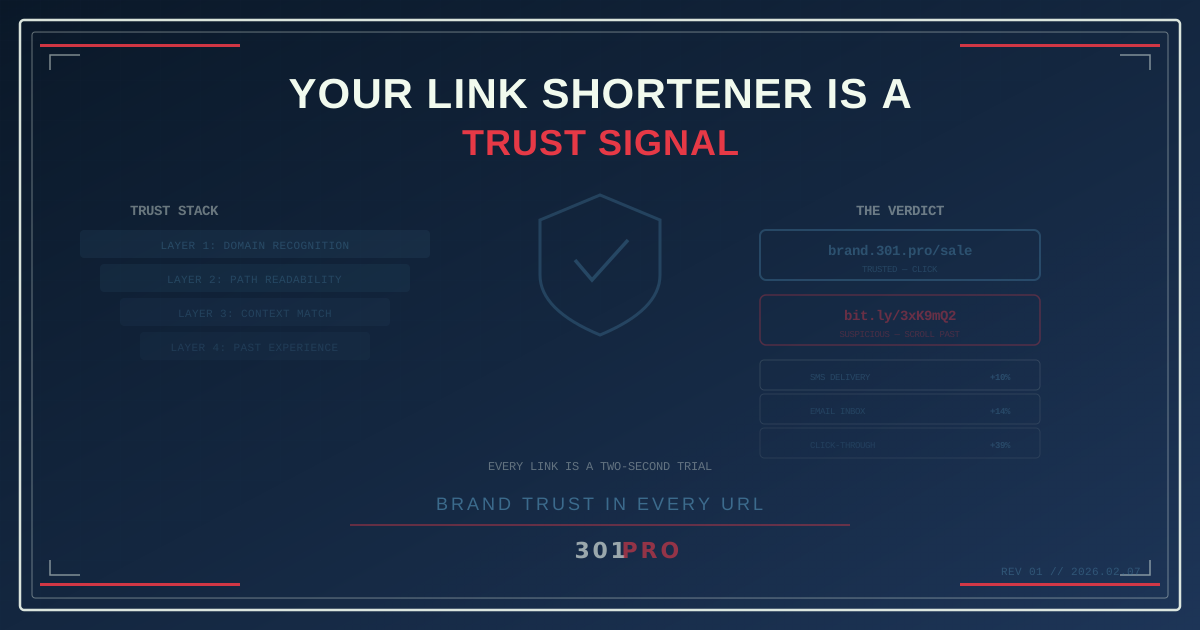
The Two-Second Trial
Every time someone encounters a shortened link, a trial happens. It takes about two seconds. The defendant is your link. The jury is the person deciding whether to tap it.
The evidence? The URL itself.
bit.ly/3xK9mQ2 — no recognizable brand, random characters, same domain used by millions of strangers including scammers. Verdict: suspicious.
yourbrand.301.pro/spring-sale — brand name visible, readable path, purpose is clear. Verdict: trustworthy.
That two-second trial happens billions of times a day across social media, text messages, emails, and print materials. And most marketers don’t realize their link shortener is actively working against them in that courtroom.
Links Are Uniforms
Think about trust signals in physical spaces. A person in a branded uniform carrying an ID badge walks into your office building — you probably hold the door. A person in street clothes with no identification? You ask who they’re here to see.
The link shortener you use is your URL’s uniform. A branded domain tells the recipient: “This link belongs to a known entity. We put our name on it.” A generic shortener says: “This could be from anyone. Proceed with caution.”
This isn’t just psychology. It’s measurable behavior. Branded short links consistently outperform generic ones in click-through rates — because trust directly influences the decision to click.
The Trust Stack
Trust in a shortened link isn’t a single factor. It’s a stack of signals that the recipient evaluates — mostly unconsciously — before deciding to click:
Layer 1: Domain Recognition
The most important trust signal is the domain itself. Does the recipient recognize it?
yourbrand.301.pro— your brand is the first thing they seelinks.yourbrand.com— even stronger, it’s your own domainbit.ly— recognized as a shortener, but not as YOUR brandt.co— Twitter’s shortener, context-dependentunknown-domain.xyz/3kQ9— maximum suspicion
The domain is the uniform. Your brand name in the URL immediately signals legitimacy.
Layer 2: Path Readability
After the domain, the path tells a story:
/spring-sale— the destination is obvious/product/demo— clear intent/3xK9mQ2— random noise, no information
Readable paths reduce uncertainty. The recipient can predict where the link leads before clicking. Random character strings offer zero predictability, which reads as higher risk.
Layer 3: Context Match
Does the link match the context in which it appears? A branded link in a marketing email from the same brand feels natural. A generic short link in a text message from an unknown number feels like smishing.
Context match isn’t about the link itself — it’s about how the link fits into the surrounding message. But branded links inherently match better because the brand name creates consistency between the message and the link.
Layer 4: Past Experience
Has the recipient clicked a link from this domain before? If they’ve visited yourbrand.301.pro links three times and had good experiences, they’ll click the fourth time without hesitation. Trust compounds.
Generic shortener domains don’t build this memory. Every bit.ly link looks identical to every other bit.ly link. There’s no past experience to draw on because the domain is shared by millions of unrelated users.
The Security Dimension
Trust signals aren’t just about marketing performance. They’re a genuine security concern.
Phishing and Smishing
Phishing attacks increasingly use generic short links to mask malicious destinations. Recipients can’t see where bit.ly/3xK9mQ2 actually leads until they click — and by then, it might be too late.
This is why SMS carriers and email providers are increasingly flagging messages containing generic short links. Not because the links are inherently malicious, but because the domain doesn’t provide enough information to assess risk.
Your legitimate marketing links get caught in this crossfire. When you share a generic short link in an SMS campaign, your message might be filtered by the same systems designed to catch smishing attacks — because your link looks identical to a smishing link.
Brand Protection
Every link you share represents your brand. A generic short link creates a disconnect between your carefully crafted brand experience and the URL delivering it. You spent thousands on brand design, copywriting, and positioning — then handed the user a URL that could belong to anyone.
Branded links maintain the chain of trust from your brand to the click destination. The user never leaves your brand’s visual ecosystem, even in the URL.
Link Hijacking
Generic shortener domains are occasionally compromised or used to redirect to malicious content. When this happens, all links using that domain are affected. Your legitimate marketing link suddenly routes through a domain with a damaged reputation.
With a branded link on your own domain or a dedicated subdomain, your link reputation is yours alone. Other people’s security problems don’t become yours.
The Deliverability Impact
Trust signals affect more than human psychology. They affect machine decisions too.
Email Deliverability
Email security systems evaluate every link in a message. Links using domains with inconsistent reputation (which is inherent to shared shortener domains) can trigger spam filters. Your perfectly legitimate newsletter lands in spam because the link shortener you used has also been used for spam by other people.
Branded links on dedicated domains have consistent, clean reputations because only your organization uses them. Email filters are more lenient with dedicated domains that have a track record of legitimate usage.
SMS Delivery
SMS carriers aggressively filter messages containing suspicious links. Generic short links are a primary trigger for SMS filtering. Campaigns using branded links see higher delivery rates because the carrier can associate the link domain with a legitimate sender.
Social Media
Platforms like LinkedIn and Twitter evaluate link quality when deciding how to distribute posts. Posts with links from domains associated with spam may receive reduced distribution. Branded links don’t carry this baggage.
The ROI of Trust
Let’s make this concrete. Consider a monthly marketing operation that shares 5,000 links across channels:
| Metric | Generic Links | Branded Links |
|---|---|---|
| SMS delivery rate | ~85% | ~95% |
| Email placement (inbox) | ~78% | ~92% |
| Click-through rate | Baseline | Significantly higher |
| Brand impressions per link | 0 | 1 |
At 5,000 links per month, that’s:
- 500 more SMS messages actually delivered per month
- 700 more emails reaching the inbox per month
- 1,000+ additional clicks per month from higher CTR
- 5,000 brand impressions per month embedded in every URL
The cumulative effect of these improvements — better delivery, better inbox placement, higher click-through, plus brand equity — easily justifies the cost of a professional link management platform.
Setting Up Trust
Moving from generic to branded links with 301.Pro is straightforward:
-
Choose your branding. Use a subdomain on 301.pro (
yourbrand.301.pro) for instant setup, or configure your own domain (links.yourbrand.com) via DNS for maximum brand control. -
Create branded links. Same link creation process you already use, but now every link carries your brand identity.
-
Deploy across channels. Start with your highest-stakes channels — SMS and email — where trust signals have the largest impact on delivery and engagement.
-
Measure the difference. 301.Pro’s analytics show click-through rates, bot vs. human traffic separation, and geographic data. Compare performance before and after the switch.
The analytics don’t change. The rules engine still works. Your QR codes still resolve. The only difference is that every link now builds trust instead of raising questions.
The Question Worth Asking
Next time you’re about to share a link, look at the URL. Does it tell the recipient anything about who you are? Does it build trust or erode it? Would you click it if you received it from someone else?
Your link shortener isn’t just a utility. It’s a trust signal broadcast to every person who encounters your content. Make sure it’s sending the right message.