Good Bots vs. Bad Bots: Why Your Link Analytics Need a Bouncer
← Back to Blog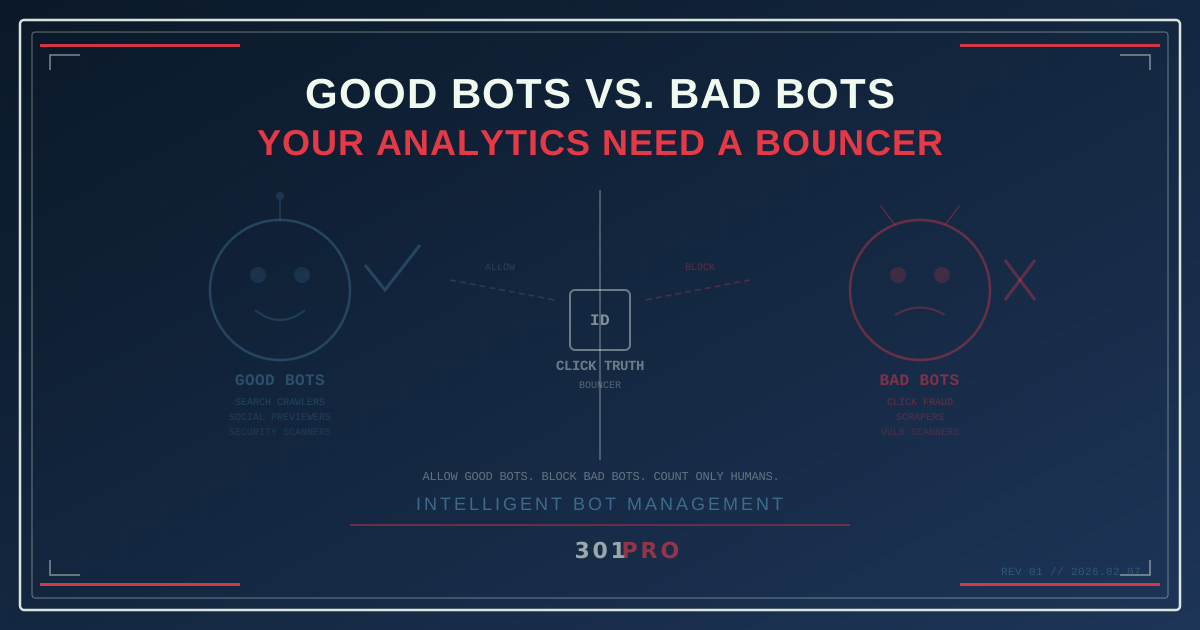
Your Analytics Have a Bouncer Problem
Imagine running a nightclub where 40% of the people inside aren’t real customers. They’re not buying drinks. They’re not dancing. They’re just… there. Walking through the door, standing around for a few seconds, and leaving. And your occupancy counter treats them exactly the same as the paying customers.
That’s what’s happening with your link analytics. Bots account for a significant portion of all web traffic, and most link analytics platforms count every single one as a “click.” Your campaign that shows 10,000 clicks? Maybe 6,000 of those were real people. Maybe fewer.
But here’s the thing that makes this complicated: not all those bots are bad. Some of them are doing useful things. The trick is telling them apart.
The Good Bots
Good bots serve a purpose. They’re the internet’s infrastructure workers — crawling, indexing, and enabling the services we rely on. Blocking all of them would break the web.
Search Engine Crawlers
Googlebot, Bingbot, and their friends crawl your links to index the destination pages. If someone shares your 301.Pro link on a blog post, search crawlers will follow that redirect to understand what it points to. This is how search engines discover and rank content.
You want these bots to follow your links. Blocking search crawlers means your content doesn’t get indexed, which means no organic traffic.
Social Media Previewers
When you paste a link into Slack, Discord, Twitter, LinkedIn, or iMessage, a bot fetches the URL to generate a preview card. It reads the Open Graph tags, grabs the title and image, and renders that nice preview.
You want these bots to access your links. Without them, your links appear as bare URLs with no context, which reduces click-through rates.
Security Scanners
Email security services like Proofpoint, Barracuda, and Microsoft Safe Links scan every URL in incoming emails. They follow the link, check the destination for malware or phishing, and then allow the email through (or flag it).
You need these bots to access your links. If you block security scanners, your emails get quarantined or your links get flagged as suspicious.
Monitoring Services
Uptime monitors, link checkers, and accessibility validators crawl your links to verify they’re working. These services help you catch broken links before your users do.
The Bad Bots
Bad bots are the reason your analytics are lying to you. They visit your links for reasons that have nothing to do with legitimate interest.
Click Fraud Bots
In the ad world, bots that click on ads waste advertising budgets. In the link analytics world, bots that click on short links inflate your engagement metrics. They make campaigns look successful when they aren’t.
Scraper Bots
These bots follow every link they find, indiscriminately, harvesting URLs, content, and metadata. They’re not interested in your campaign — they’re building databases.
Vulnerability Scanners
Malicious scanners probe your links looking for security holes. They test for open redirects, injection points, and misconfigured servers.
Competitor Intelligence Bots
Some bots crawl competitor links to reverse-engineer campaigns, destinations, and strategies. They inflate your click counts while extracting competitive intelligence.
Why This Matters for Your Analytics
Here’s a real scenario:
You’re running an SMS campaign with 301.Pro links. You send 50,000 messages. Your analytics show 12,000 clicks.
What actually happened:
| Source | Clicks | Percentage |
|---|---|---|
| Real humans | 5,200 | 43% |
| Email/SMS security pre-scanners | 4,800 | 40% |
| Social preview bots | 800 | 7% |
| Search crawlers | 400 | 3% |
| Scraper/fraud bots | 800 | 7% |
Your actual human engagement rate is 10.4%, not the 24% your raw analytics suggest. That’s a massive difference when you’re making decisions about budget allocation, campaign optimization, or reporting to stakeholders.
If you report 24% engagement to your CMO and then can’t replicate it next quarter (because the bot ratio shifted), you’ve got a credibility problem.
The Three-Tier Approach
Smart bot management isn’t “block all bots” or “allow all bots.” It’s a tiered approach:
Tier 1: Allow and Don’t Count
Good bots — search crawlers, social previewers, monitoring services. Let them through, but don’t count their visits in your click analytics.
This is harder than it sounds. Good bots typically identify themselves with honest user-agent strings. But not always. And some bad bots masquerade as good ones. The identification layer needs to be sophisticated enough to verify claims, not just trust headers.
Tier 2: Allow and Flag
Security scanners and email pre-fetch bots. You need to let them through (blocking them breaks email delivery), but you need to clearly separate their “clicks” from human engagement.
This category is especially important for SMS and email campaigns. When Microsoft Safe Links scans every URL in an email before the recipient even opens it, those scans look like clicks. Without proper filtering, every email sent becomes a “click,” which is meaningless.
Tier 3: Block or Challenge
Fraud bots, aggressive scrapers, and vulnerability scanners. These provide no value and actively harm your analytics and security. Block them, rate-limit them, or serve them a challenge.
How 301.Pro Handles This
301.Pro’s Intelligent Bot Management is built specifically for link analytics. It doesn’t just count clicks — it classifies them.
Intelligent Bot Management is the analytics layer that separates real human clicks from bot traffic. When you look at your dashboard, you see clean numbers — the clicks that represent real people making real decisions. Bot traffic is tracked separately, so you can see it if you want, but it doesn’t contaminate your campaign metrics.
The system works across multiple signals:
- User-agent analysis — identifying known bots by their declared identity
- Behavioral patterns — bots behave differently than humans (timing, navigation patterns, request characteristics)
- Request fingerprinting — technical characteristics of the request that distinguish automated clients from real browsers
- Rate analysis — sudden spikes from single sources that indicate automated crawling
This isn’t a binary filter. It’s a confidence-scored classification that places each click on a spectrum from “definitely human” to “definitely bot,” with appropriate handling at each level.
The “But I Want High Numbers” Trap
Some marketers resist bot filtering because it makes their numbers go down. If your report shows 20,000 clicks, and filtering reveals only 12,000 are human, that feels like a loss.
It’s not. Those 8,000 bot clicks were never real. They never converted. They never bought anything. They were phantom engagement that made your campaign look better than it was.
Clean analytics let you:
- Accurately measure ROI — your cost-per-click and conversion rates are based on real humans
- Compare campaigns fairly — some channels attract more bots than others; without filtering, you’re comparing apples to spam
- Optimize effectively — if you’re optimizing toward inflated metrics, you’re optimizing toward bots, not customers
- Report credibly — stakeholders trust numbers that can be reproduced and verified
What to Do About It
If you’re currently using a link shortener or analytics platform that doesn’t differentiate between bot and human traffic, you’re flying with dirty instruments. Every metric you look at is contaminated.
Here’s how to start cleaning up:
-
Audit your current data. Look at your click logs. Do you see clusters of clicks that happen within milliseconds of a link being sent? Those are probably pre-scanners, not humans.
-
Check your SMS/email campaigns especially. These channels have the highest bot-to-human ratios because of security scanning. If your email click rate seems impossibly high, bots are probably the reason.
-
Switch to analytics that classify traffic. 301.Pro’s Intelligent Bot Management is built for this exact problem. Your dashboard shows human engagement by default, with bot traffic available in a separate view.
-
Re-baseline your metrics. Once you have clean data, recalculate your benchmarks. Your “real” click-through rates will be lower, but they’ll be accurate — and that’s the foundation for making good decisions.
The Bottom Line
Bots aren’t going away. If anything, they’re getting more sophisticated. The good ones are essential to how the internet works. The bad ones are a tax on your analytics accuracy.
Your link analytics need a bouncer — something that lets the right visitors in, keeps the bad actors out, and most importantly, gives you an honest count of who actually showed up. That’s not a nice-to-have feature. It’s the difference between making decisions based on real data and making decisions based on fiction.