What Is Generative Engine Optimization (GEO) and Why Should Link Managers Care?
← Back to Blog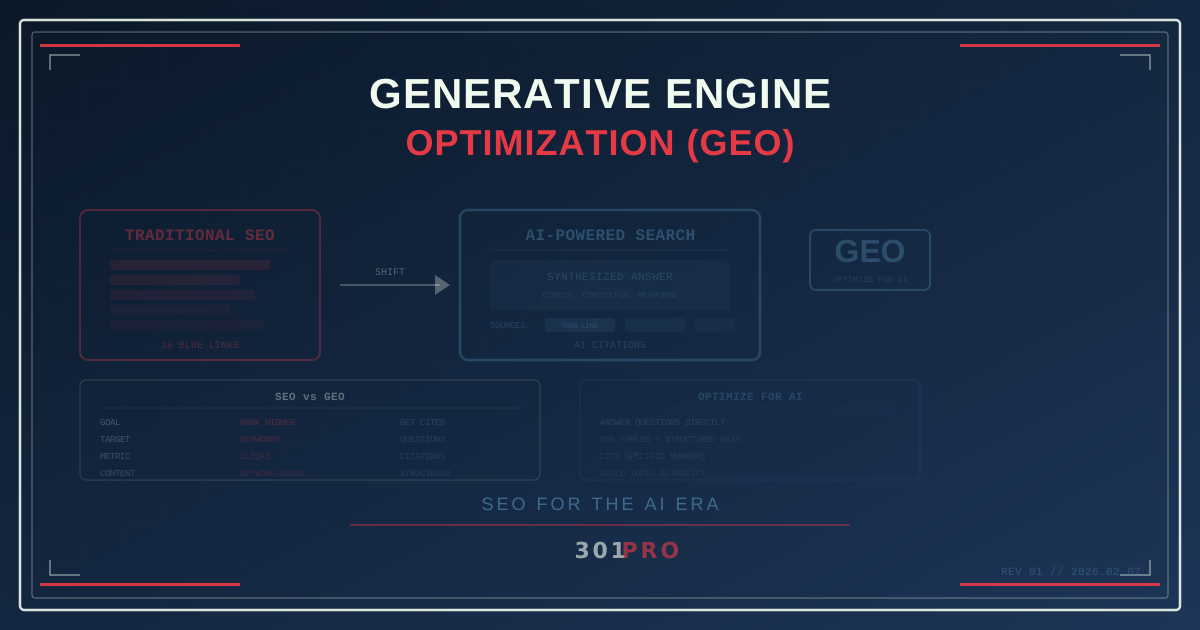
The Search Box Is Disappearing
For twenty years, digital marketing had one game: get your page to rank on Google. Blue links. Page one. Position three or higher. That was the whole playbook.
Then AI assistants showed up and started answering questions directly. Instead of ten blue links, users get a synthesized answer with a few citations at the bottom. The search box isn’t gone — but it’s sharing the stage with something fundamentally different.
This shift has a name: Generative Engine Optimization (GEO). And if you manage links, campaigns, or content distribution for a living, it changes more than you think.
What GEO Actually Means
Traditional SEO optimizes content for search engine crawlers. You structure your HTML, target keywords, build backlinks, and hope Google’s algorithm ranks you favorably.
GEO optimizes content for AI models that synthesize answers. When someone asks Claude, ChatGPT, or Google’s AI Overview a question, the model pulls from its training data and retrieval sources to construct an answer. If your content is one of those sources, you get cited. If it’s not, you don’t exist.
The difference is subtle but important:
| Traditional SEO | GEO |
|---|---|
| Optimize for ranking position | Optimize for citation probability |
| Target keywords | Target questions and concepts |
| Build backlinks for authority | Build structured, authoritative content |
| Compete for click-through | Compete for inclusion in AI answers |
| User visits your page | User sees your brand in a citation |
GEO doesn’t replace SEO. It runs alongside it. But the content strategies that win in GEO are different from the ones that win in traditional search.
Why Link Managers Should Pay Attention
If you’re managing links and campaigns, GEO affects you in three specific ways:
1. Traffic Attribution Is Changing
When an AI assistant cites your content, the user might click through — or they might not. They got the answer already. The click-through rate from AI citations is significantly lower than from traditional search results.
This means your analytics need to account for a new type of visibility: zero-click exposure. Your brand appeared in an AI answer. The user saw your name. They didn’t click, but they now associate your brand with expertise on that topic.
Traditional link analytics don’t capture this. You need attribution models that account for brand impressions beyond clicks. 301.Pro’s Click Data Enrichment already separates human clicks from bot traffic — the next frontier is understanding which clicks originated from AI-assisted discovery versus traditional search.
2. Content Structure Matters More Than Keywords
AI models don’t scan for keywords the way traditional search crawlers do. They parse meaning. They look for:
- Clear, direct answers to specific questions
- Structured data — tables, lists, step-by-step processes
- Authoritative sourcing — citations, statistics, named sources
- Specificity — concrete numbers, real examples, not vague generalizations
This is actually good news for content marketers who write substantive material. The AI rewards depth over keyword density. A well-structured blog post that directly answers a question has a better chance of being cited than a keyword-stuffed page with thin content.
3. Your Link Strategy Needs an AI Layer
Here’s where it gets practical for link managers. When AI assistants cite your content, the citation typically includes a URL. That URL needs to:
- Actually work — broken links in AI citations are brand-damaging
- Lead somewhere useful — not a homepage, but the specific content that was cited
- Be trackable — you need to know when traffic comes from an AI citation
If you’re using 301.Pro to manage your links, you already have the infrastructure for this. Your managed links won’t break even if you restructure your site. Your rules engine can route AI-referral traffic to optimized landing pages. Your analytics can identify and segment traffic patterns that suggest AI-assisted discovery.
The Content Strategy for GEO
Writing content that gets cited by AI requires a different approach than writing for Google’s traditional algorithm:
Answer Questions Directly
AI models are trained to find answers. If your content poses a question and then buries the answer under five paragraphs of preamble, the AI will look elsewhere. Lead with the answer, then provide supporting detail.
Use Structured Formats
Tables, numbered lists, and comparison charts are AI citation gold. They’re easy for models to parse and extract. If you can present information in a structured format, do it.
Be Specific and Cite Sources
Vague claims don’t get cited. “Marketing ROI improves significantly” is invisible to AI. “Branded short links consistently outperform generic short links in click-through rates across multiple industry studies” is citable. Specific observations, named sources, concrete examples.
Create Topic Authority
AI models assess authority across a body of work, not just a single page. Publishing multiple related, interlinked posts on a topic signals expertise. If you have ten well-written posts about link management, the AI is more likely to cite any one of them than if you have a single post.
This is where a consistent content strategy — like a blog that regularly covers link management, QR codes, redirect strategy, and analytics — builds compound authority over time.
Keep Content Fresh
AI models increasingly prefer recent content. A post from 2023 about “the future of QR codes” is less likely to be cited than a 2026 post covering the same topic with current data. Keep your cornerstone content updated.
The Measurement Problem
The biggest challenge with GEO is measurement. Traditional SEO has clear metrics: rankings, impressions, clicks, conversions. GEO metrics are still evolving:
- Citation tracking: Some tools now monitor when AI assistants cite your content, but coverage is incomplete
- Brand mention monitoring: Tracking when your brand appears in AI-generated answers
- Referral pattern analysis: Identifying traffic spikes that correlate with AI citation events
- Zero-click brand lift: Measuring awareness increases that don’t come with clicks
301.Pro’s analytics can help with the traffic analysis side — segmenting AI-referral traffic, tracking which managed links receive citation-driven clicks, and filtering bot traffic from genuine AI-referred humans. But the full GEO measurement stack is still maturing.
What to Do Right Now
You don’t need to overhaul your entire content strategy for GEO. Start with these practical steps:
-
Audit your top content for AI-readability. Does it directly answer questions? Is it structured with headers, lists, and tables? Does it cite specific data?
-
Ensure your managed links are stable. AI citations persist. A link cited by an AI model today might drive traffic for months. Make sure your link infrastructure — ideally through a platform like 301.Pro — keeps those URLs alive indefinitely.
-
Add structured data. FAQ schema, how-to schema, and article schema help AI models understand and cite your content.
-
Monitor AI mentions. Set up alerts for your brand name appearing in AI-generated content. Several monitoring tools now support this.
-
Write for questions, not just keywords. Frame your content around the questions your audience actually asks. Each section of a blog post can target a specific question.
The Bigger Picture
GEO isn’t replacing SEO — it’s expanding the surface area of search. Your content now competes in two arenas: traditional search rankings and AI citation inclusion. The brands that win are the ones optimizing for both.
For link managers specifically, this means your infrastructure matters more than ever. The links you manage today might be cited by AI assistants tomorrow. They need to be permanent, trackable, and pointed at the right destinations. That’s not a new requirement — it’s the same reason you use a link management platform in the first place.
The search box is changing. Your links need to be ready for wherever the traffic comes from next.