The Future of the Click: What Happens After the Cookie Disappears
← Back to Blog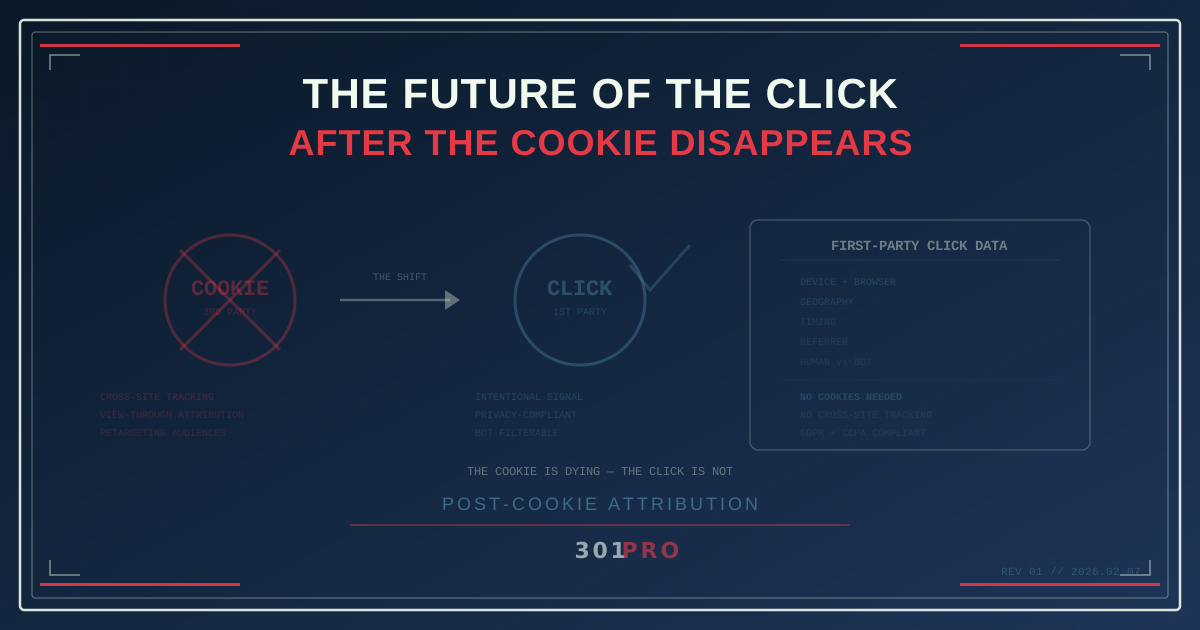
The Measurement Crisis
For two decades, digital marketing ran on third-party cookies. You visited a shoe website, and that shoe followed you across the internet. The tracking was invisible, persistent, and effective. Marketers built entire attribution models on it.
Then everything changed.
Safari blocked third-party cookies. Firefox blocked them. Chrome finally followed. GDPR gave European users the right to refuse tracking. CCPA did the same for California. Apple’s App Tracking Transparency decimated mobile attribution. Ad blockers reached 40%+ penetration among desktop users.
The infrastructure that powered digital advertising attribution for twenty years is gone. And marketers are scrambling to answer a question that used to be trivial: “Did our marketing work?”
What We Lost
The cookie-based attribution model was simple. Track a user across websites. See which ad they clicked. Watch them browse. Record when they bought. Attribute the sale to the ad.
Without cookies, that chain breaks at nearly every link:
- Cross-site tracking: Gone. You can’t follow users across websites.
- View-through attribution: Dying. You can’t prove someone saw your ad on another site.
- Retargeting audiences: Shrinking. You can’t reliably identify users across sessions.
- Multi-touch attribution: Compromised. You can’t track the full journey across platforms.
This isn’t a future prediction. It’s the current reality. The data pipeline that marketers relied on is broken, and it’s not coming back.
What We Still Have: The Click
In the post-cookie landscape, one signal survives intact: the click.
When someone clicks a link, that action is:
- Intentional: The user chose to click. It’s a moment of genuine interest.
- First-party: The click happens on your link, your domain, your infrastructure.
- Measurable: You own the redirect. You see every click.
- Privacy-compliant: You’re measuring an action on your own property, not tracking someone across the internet.
- Bot-filterable: With the right technology, you can separate human clicks from automated traffic.
The click is the surviving signal in the post-cookie world. And it’s arguably a better signal than cookies ever provided, because it represents actual intent rather than passive browsing.
First-Party Data Is the New Gold
The industry has a phrase for the shift: “first-party data strategy.” It means collecting data from your own touchpoints rather than relying on third-party tracking.
Link clicks are the purest form of first-party data in marketing. When someone clicks your link:
- You know it happened (the redirect proves it)
- You know when it happened (timestamp)
- You know roughly where they are (IP geolocation)
- You know what device they used (user agent)
- You know what they clicked on (the link and its context)
- You DON’T need cookies, pixels, or third-party tracking
301.Pro’s Click Data Enrichment was designed for this exact reality. Every click through a 301.Pro link captures first-party data — device, geography, timing, referrer — without cookies, without cross-site tracking, and without privacy concerns.
This is why we call it a “new tracking standard.” It’s not a workaround for lost cookies. It’s a fundamentally different approach that’s both more privacy-respecting and more reliable.
The Attribution Shift
Without cookies, attribution models are changing in three ways:
From Multi-Touch to Click-Based
Multi-touch attribution required tracking users across multiple sessions and platforms — exactly what cookies provided. Without them, attribution is shifting toward click-based models: what links drove clicks, and what happened after those clicks.
This is less granular than cookie-based multi-touch, but it’s based on actual actions rather than passive tracking. A click is a stronger signal of interest than a page view that happened because a cookie fired in the background.
From Third-Party to First-Party
Instead of relying on Google, Facebook, or ad networks to report what happened with your campaigns, first-party attribution puts you in control. You own the link. You see the click. You connect it to the outcome.
301.Pro’s First Party Pixel technology takes this further — tracking engagement without the ad blocker and browser restrictions that break traditional pixels. The data stays on your property, under your control.
From User Tracking to Interaction Tracking
The old model tracked users: who they are, where they’ve been, what they’ve viewed. The new model tracks interactions: what links were clicked, from where, on what devices, at what times.
This shift is philosophically important. You’re measuring the effectiveness of your marketing activities, not surveilling individual users. It’s better for privacy. It’s also better for accuracy — measuring real interactions instead of inferred browsing behavior.
What This Means for Link Management
If clicks are the surviving measurement signal, then the quality of your click data matters enormously. This is where link management platforms become critical infrastructure rather than nice-to-have tools.
Bot Filtering Is Essential
When clicks are your primary attribution signal, inflated click counts aren’t just misleading — they’re dangerous. If 40% of your clicks are bots and you’re making attribution decisions based on those clicks, your entire marketing budget is misallocated.
Bot filtering isn’t optional in a click-based attribution world. It’s table stakes. Your link management platform must separate human engagement from machine noise, or your data is fiction.
Enriched Click Data Replaces Lost Cookie Data
Cookies provided context: what browser, what platform, what page, what session. Without cookies, your click data needs to provide similar context through first-party methods.
Click Data Enrichment captures device type, operating system, browser, geographic location, time of click, referrer information, and human-vs-bot classification — all from the redirect event itself. No cookies required. No cross-site tracking. No privacy concerns.
Link Infrastructure Becomes Campaign Infrastructure
In the cookie era, links were just navigation. Click here, go there. The real measurement happened through cookies and pixels.
In the post-cookie era, the link IS the measurement. The redirect event is where you capture attribution data. Your link infrastructure is your measurement infrastructure.
This is why investing in a link management platform like 301.Pro isn’t just about shorter URLs or branded domains — it’s about building the first-party data foundation that your marketing attribution depends on.
The Privacy Advantage
Here’s the counterintuitive reality: the death of cookies is actually good for marketers who invest in first-party measurement.
Cookie-based tracking was always fragile. It depended on third-party infrastructure you didn’t control. Any browser update, any privacy regulation, any ad blocker could (and did) break it overnight.
First-party click data is robust. You own the link. You control the redirect. You capture the data. No browser update can take that away. No ad blocker can prevent a redirect from happening. No privacy regulation prohibits measuring interactions on your own property.
The marketers who shift to first-party measurement aren’t just complying with privacy regulations — they’re building a more reliable, more durable measurement foundation than cookies ever provided.
The Practical Path Forward
For marketing teams adapting to the post-cookie world:
-
Invest in link management infrastructure. Your links are now your primary measurement points. Make sure they’re managed, tracked, and enriched.
-
Enable bot filtering immediately. In a click-based attribution world, clean data isn’t optional.
-
Deploy first-party tracking. Use first-party pixels and click data enrichment instead of third-party cookies and tracking pixels.
-
Build click-based attribution models. Work with your analytics team to develop models that use click data as the primary signal, supplemented by other first-party data.
-
Use managed links everywhere. Every link you share should be trackable through your link management platform. Unmanaged direct links are unmeasured touchpoints — gaps in your attribution data.
-
Embrace the shift. The post-cookie world isn’t a downgrade. It’s a transition to more honest, more reliable, more privacy-respecting measurement. The data you get is better. The signal is cleaner. The attribution is based on real actions, not inferred behavior.
The Bottom Line
The cookie is dying. The click is not.
In fact, the click is more important than ever. It’s the measurable moment of intent that survives every privacy regulation, every browser update, and every ad blocker. It’s first-party. It’s intentional. It’s real.
The question isn’t whether clicks matter in the post-cookie world. The question is whether your link infrastructure is ready to capture, enrich, and analyze them.
The future of digital measurement isn’t tracking where users have been. It’s understanding what they chose to click on and where that interest led. That’s the future of the click. And it starts with the link.