The Franchise Marketing Playbook: One Campaign, 500 Locations, Zero Chaos
← Back to BlogPart of: Franchise & Multi-Location Marketing
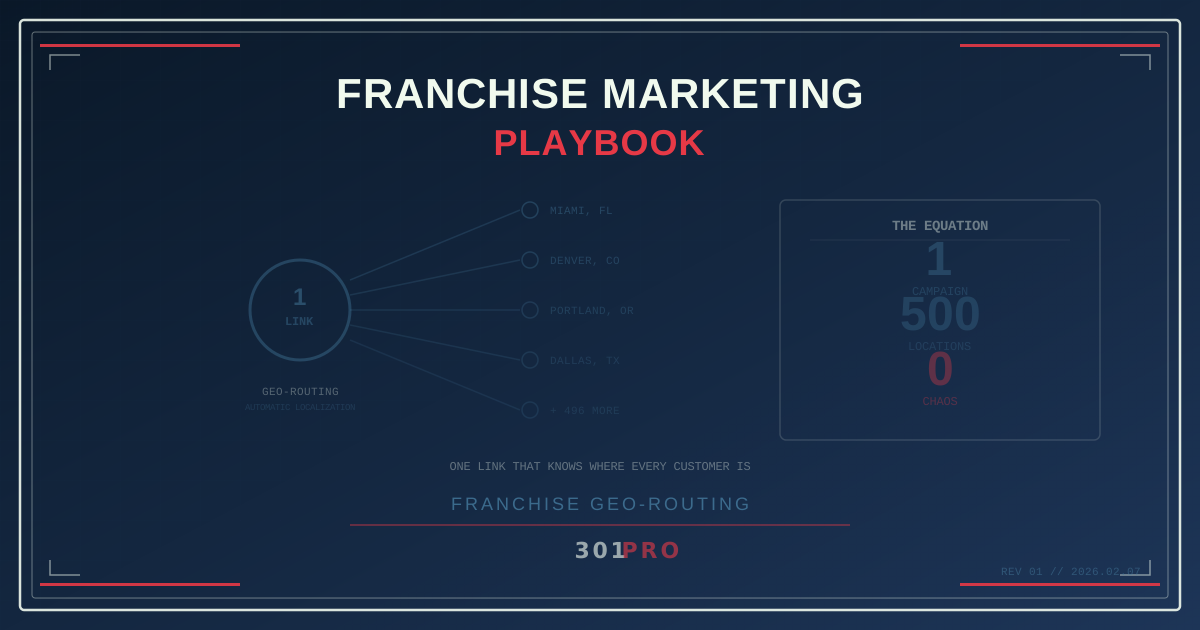
The Franchise Marketing Nightmare
You’re the marketing director for a franchise with 500 locations. Corporate just approved a national TV campaign. The ad ends with “Visit our website to find your nearest location.”
Now you need a link that works for all 500 locations. In Miami, it should send people to the Miami store page. In Denver, the Denver store page. In Portland — well, you have three Portland locations, so it should probably pick the closest one.
The old way to solve this: create a “store locator” page and hope people are willing to type in their zip code. The reality? Most people bounce. They wanted a direct answer, not a homework assignment.
The new way: one link that already knows where the customer is and sends them to the right page automatically.
Why Franchises Are Uniquely Hard
Franchise marketing sits at the intersection of two competing needs:
Brand consistency. Corporate wants one message, one campaign, one brand experience. The national ad should look and feel the same whether you’re watching it in Texas or Maine.
Local relevance. The customer in Texas doesn’t care about the Maine location. They want their store, their hours, their inventory, their local promotions. Generic national landing pages feel disconnected.
Most marketing tools force you to choose: one generic national campaign, or 500 separate local campaigns. The first feels impersonal. The second is a logistics nightmare.
Geo-routing eliminates the trade-off. One campaign, one link, locally relevant destinations for every customer.
How Geo-Routing Works for Franchises
301.Pro’s rules engine evaluates every click and routes it based on the user’s location. For a franchise, the setup looks like this:
Step 1: Create One Link
You create a single short link: 301.pro/cde/visit-us. This is the link that appears on your TV ad, your social posts, your print mailers, and your email campaigns.
Step 2: Define Location Rules
In your 301.Pro dashboard, you set up geographic rules:
| User Location | Destination |
|---|---|
| Miami, FL metro | franchise.com/locations/miami-south-beach |
| Denver, CO metro | franchise.com/locations/denver-downtown |
| Portland, OR metro | franchise.com/locations/portland-pearl |
| Default (anywhere else) | franchise.com/store-locator |
You can define rules by metro area, state, zip code radius, or even GPS coordinates. The granularity is up to you.
Step 3: Deploy Everywhere
That single link goes everywhere. One QR code for the national print campaign. One link for the TV commercial. One URL for the social media bio. Every instance of the link routes intelligently based on where the customer actually is.
Step 4: Measure by Location
Your analytics break down by location automatically. You can see which metro areas generated the most clicks, which locations have the highest engagement, and which markets aren’t responding to the campaign.
The Real-World Scenarios
National TV + Local Landing
A restaurant franchise runs a national TV spot for a new menu item. The CTA is a QR code that says “Order Now.” Each scan routes to the nearest location’s online ordering page. A customer in Chicago sees the Chicago location’s menu. A customer in Atlanta sees Atlanta’s. No store locator. No friction.
Regional Promotions, National Links
Different regions run different promotions — 20% off in the Midwest, buy-one-get-one on the East Coast, free delivery on the West Coast. One link can route to different promotional landing pages based on the user’s region. Corporate sends one email. Every recipient gets their local offer.
Printed Materials That Stay Current
A franchise prints flyers with a QR code for holiday promotions. In November, the link routes to Black Friday deals. In December, it switches to holiday catering. In January, it becomes New Year specials. The flyer doesn’t change. The destination does.
This is the power of dynamic links — the printed material is permanent, but the digital destination is infinitely flexible. We’ve covered this concept in our posts about dynamic QR codes.
Event-Specific Routing
A franchise sponsors a national sporting event. The same branded link on all signage routes to different pages depending on the stadium location. Fans at the Dallas venue see the Dallas franchisee’s promotions. Fans at the Boston venue see Boston’s. One sponsorship, localized results.
The Analytics Advantage
For franchises, local analytics aren’t a nice-to-have — they’re essential for managing franchisee relationships and allocating marketing spend.
With 301.Pro’s Click Data Enrichment, every click on your franchise link captures:
- Geographic data — which metros, states, and zip codes generated clicks
- Device data — mobile vs. desktop, useful for understanding how customers discovered the link
- Time data — when people are clicking, broken down by time zone
- Bot filtering — separating genuine customer interest from automated traffic
This data helps answer critical franchise questions:
- Which markets should get more marketing budget?
- Are rural locations underperforming because of low awareness or low demand?
- Which time slots generate the most engagement in each region?
- Is the national campaign reaching all markets equally?
The Franchisee Communication Problem
Here’s a pain point that every franchise marketer knows: communicating with franchisees.
Without geo-routing, running a national campaign means either sending every franchisee a unique link (and hoping they use it correctly) or using one generic link that doesn’t benefit any specific location.
With geo-routing, corporate controls the link. Franchisees don’t need to do anything. The routing is automatic, the analytics are centralized, and the campaign just works. No confused franchise owners asking why their link doesn’t work. No conflicting local campaigns undermining the national message.
The Multi-Language Angle
Many franchises operate across language boundaries — Spanish-speaking markets in the Southwest, French-speaking areas in parts of Canada and Louisiana, and increasingly diverse metro areas everywhere.
301.Pro’s rules engine can route based on the user’s browser language settings, not just geography. A customer in Miami whose phone is set to Spanish sees the Spanish-language landing page. A customer in the same city whose phone is set to English sees the English version.
One link. Automatic language routing. No separate campaigns for each language.
Implementation for Franchise Marketers
If you’re managing marketing for a franchise, here’s how to get started:
-
Identify your top campaigns. Start with your highest-visibility national campaigns — TV, national print, major social pushes. These benefit most from geo-routing.
-
Map your locations to geo-rules. Create a spreadsheet that maps each franchise location to its geographic area and destination URL. This becomes your routing configuration.
-
Set up a default. For locations or regions you haven’t mapped specifically, route to a store locator or general landing page. No click should dead-end.
-
Brief your franchisees. Let them know that one link will route customers to their location automatically. They’ll want to know that their market is covered.
-
Monitor and optimize. Use the per-location analytics to identify underperforming markets and adjust spend or creative accordingly.
The Scale Equation
The beauty of geo-routing for franchises is that complexity doesn’t scale linearly. Whether you have 50 locations or 5,000, the campaign execution is the same: one link, one QR code, one set of creative. The routing rules handle the complexity.
Adding a new location? Add a geo-rule. Closing a location? Remove the rule and redirect that area’s traffic to the next nearest location. Opening in a new market? Add the geo-rule before the first local marketing campaign, and the national links already work for the new area.
The Bottom Line
Franchise marketing doesn’t have to be a choice between national efficiency and local relevance. Geo-routing gives you both — one campaign that feels local everywhere.
One link. 500 locations. Zero chaos. That’s the franchise marketing playbook.