Third-Party Cookies Are Dead. Your Links Are Your New Attribution Layer.
← Back to Blog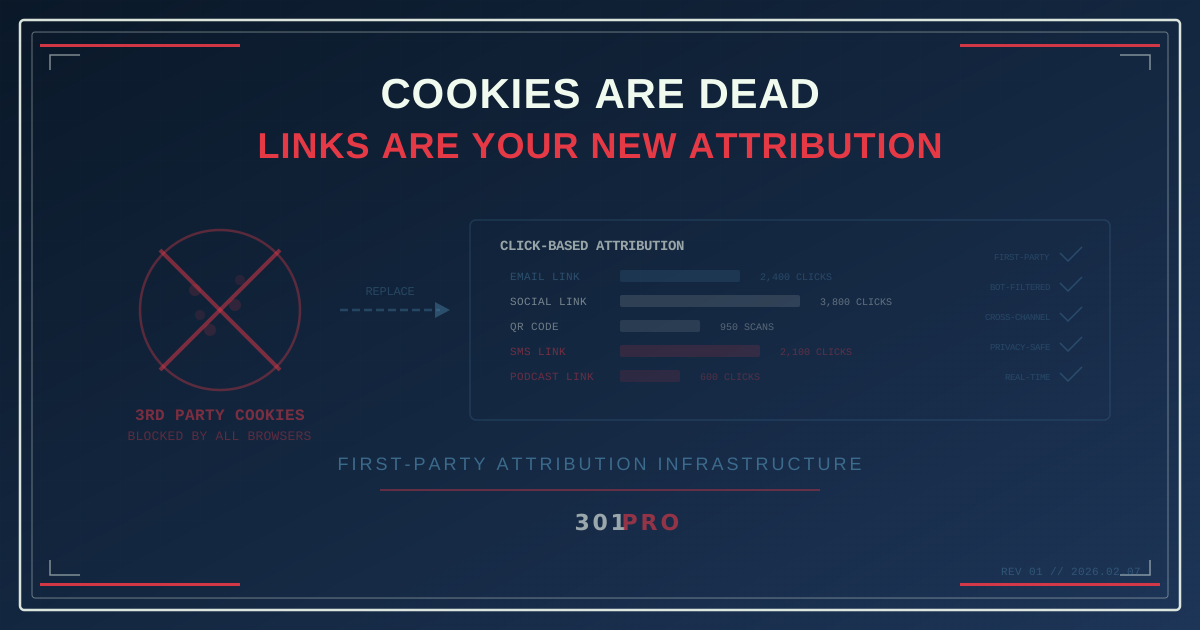
The Cookie Crumbled
For over a decade, third-party cookies were the invisible backbone of digital marketing attribution. User clicks ad. Cookie gets set. User buys product three days later. Cookie says, “That was the ad.” Marketing reports show the conversion. Everyone’s happy.
Then Safari killed third-party cookies in 2020. Firefox followed. And Chrome — which held out the longest because Google’s entire ad business depended on them — finally pulled the plug.
The result? The attribution model that powered most of digital marketing is gone. And marketers are scrambling.
The CPMs didn’t change. The ad spend didn’t change. What changed is your ability to prove that any of it works. You’re still spending $50,000 a month on campaigns, but your attribution reports now have holes big enough to drive a truck through.
What Broke and Why It Matters
Third-party cookies solved a specific problem: tracking a user across multiple websites without their explicit cooperation. You could follow someone from a Facebook ad to your landing page to a review site to your checkout, stitching together a cross-domain journey that told a coherent attribution story.
Without those cookies, each website is an island. Your ad platform knows someone clicked. Your website knows someone bought. But connecting those two events requires a handshake that third-party cookies used to provide for free.
Here’s what’s actually broken:
- Multi-touch attribution: You can’t track the full journey from first touch to conversion across domains
- View-through conversions: You can’t attribute a purchase to an ad the user saw but didn’t click
- Cross-device tracking: You can’t connect a mobile ad view to a desktop purchase
- Retargeting audiences: You can’t build pixel-based audiences across third-party sites
- Conversion reporting: Your reported ROAS is probably understated because you’re missing conversions
The attribution gap isn’t theoretical. Marketers widely report materially fewer attributed conversions in post-cookie environments — not because conversions dropped, but because they can’t track them anymore.
Links as First-Party Attribution Infrastructure
Here’s the insight that changes everything: every click on a link you control is a first-party data event.
When someone clicks a 301.Pro link, the click happens on your domain (or your branded short domain). That’s first-party. No third-party cookie required. The click itself carries attribution data — where it came from, when it happened, what device was used, what location the user is in.
This isn’t a workaround. It’s actually a better model. Instead of relying on passive cookie tracking that users can (and do) block, you’re capturing attribution at the moment of intent — the click.
What a Click Tells You (Without Cookies)
Every click through 301.Pro’s Click Data Enrichment captures:
| Data Point | How It’s Captured | Attribution Use |
|---|---|---|
| Source channel | Which link was clicked | Campaign attribution |
| Device type | User agent at click time | Cross-device analysis |
| Geography | IP geolocation | Regional campaign performance |
| Time of click | Server timestamp | Time-decay attribution |
| Referring context | HTTP referrer | Channel identification |
| Bot vs. human | Behavioral analysis | Clean conversion data |
None of this requires a cookie. It’s all captured at the redirect — in the milliseconds between the click and the destination page load.
Building a Cookie-Free Attribution Model
Step 1: Structure Your Links as Attribution Tags
Instead of relying on UTM parameters that get stripped or mangled, use distinct smart links for each campaign touchpoint:
| Channel | Link | Destination |
|---|---|---|
| Email newsletter | 301.pro/cde/spring-email | Landing page |
| Instagram bio | 301.pro/cde/spring-ig | Landing page |
| Podcast mention | 301.pro/cde/spring-pod | Landing page |
| SMS blast | 301.pro/cde/spring-sms | Landing page |
| QR code (print) | 301.pro/cde/spring-qr | Landing page |
Same destination. Different links. Each click is automatically attributed to the right channel without any UTM parameters, without any cookies, and without any client-side JavaScript.
Step 2: Use First-Party Pixel Analytics
301.Pro’s First Party Pixel sits on your domain. It captures arrival data that connects the click (from step 1) to the on-site behavior (page views, form fills, purchases). Because it’s first-party, browsers don’t block it. Ad blockers don’t strip it. Privacy regulations treat it differently from third-party tracking.
The flow:
- User clicks your 301.Pro link (click captured)
- User lands on your site (first-party pixel fires)
- User browses, adds to cart, purchases (pixel tracks the journey)
- Attribution connects the purchase back to the specific link clicked in step 1
No third-party anything. The entire chain is first-party.
Step 3: Connect Click Data to Conversions
With 301.Pro’s Real-Time Webhooks (available on higher-tier plans), click events can fire into your analytics platform, CRM, or data warehouse in real time. This means:
- A click from your email campaign triggers a webhook
- Your CRM tags the contact as “engaged with spring campaign”
- When that contact converts, the attribution is already in place
- No cookie matching required
Step 4: Layer in Bot Filtering
Here’s where most attribution falls apart: bots. Email security scanners click links before humans do. Social media crawlers hit every shared URL. Link preview generators fire requests that look like clicks.
If you count those as conversions or campaign engagements, your attribution data is garbage. 301.Pro’s Intelligent Bot Management filters automated traffic before it enters your analytics pipeline. The click data you’re attributing is real human behavior — not noise.
What This Looks Like in Practice
Scenario: Multi-Channel Product Launch
You’re launching a new product across five channels: email, paid social, organic social, influencer partnerships, and podcast ads.
Old model (cookies): One link with UTM parameters. Rely on Google Analytics to stitch together the journey using cookies. When cookies get blocked, the journey breaks. Your “last click” attribution says organic search gets all the credit because that’s the only touchpoint GA can see.
New model (link-based): Five distinct 301.Pro links, one per channel. Each click is attributed at the moment it happens. Your analytics dashboard shows:
- Email drove 2,400 clicks, 180 landing page views (7.5% scroll rate)
- Paid social drove 8,000 clicks, but 4,200 were bots (301.Pro filtered them)
- Podcast drove 600 clicks with the highest on-site engagement time
- Influencer links drove 3,100 clicks with the best geographic spread
This data is clean, complete, and cookie-independent. You know exactly which channels drove real engagement — not what the cookie-based model guessed.
Scenario: Offline-to-Online Attribution
Cookies never worked for offline channels anyway. You couldn’t cookie a billboard, a direct mail piece, or a conference badge.
QR codes and short links solve this. A QR code on a direct mail piece links to 301.pro/cde/mailer-q1. Every scan is captured with full click data enrichment. You now have first-party attribution data for a channel that was previously a black box.
The same link-based model that replaces cookies for digital channels has always been the only option for offline channels. Now your entire marketing mix uses the same attribution framework.
The Privacy Advantage
Cookie-based attribution always had a privacy problem. Users didn’t consent to being tracked across websites. GDPR and CCPA cracked down on it. Apple’s App Tracking Transparency crushed it further.
Link-based attribution is fundamentally different:
- It’s first-party: The click happens on your domain, not a third-party tracker
- It’s event-based: You’re tracking a discrete action (a click), not persistent surveillance
- It’s transparent: The user chose to click; that’s explicit engagement
- It’s anonymized: Click data enrichment captures aggregate patterns, not personal identity graphs
- It’s compliant by design: No consent banner needed for first-party click analytics
You’re not rebuilding the cookie surveillance system with different technology. You’re building something better — attribution that works with privacy regulations instead of around them.
What You Lose (And What You Gain)
Let’s be honest: link-based attribution doesn’t replicate everything cookies did.
What you lose:
- View-through attribution (saw an ad but didn’t click)
- Passive cross-site tracking
- Look-alike audience building from third-party data
What you gain:
- Attribution data that’s actually accurate (no cookie deletion, no browser blocking)
- Clean data (bot-filtered)
- Offline channel attribution (finally)
- Privacy compliance without complex consent frameworks
- Real-time data delivery via webhooks
- Cross-channel comparison on equal footing
The view-through loss stings. But here’s the truth: view-through attribution was always the fuzziest number in your reports. “Someone might have seen your ad and then bought something later” was never the rigorous measurement it pretended to be.
The Bottom Line
Third-party cookies gave marketers a convenient fiction: that they could track users everywhere, all the time, with perfect attribution. That fiction is over.
Links give you something real: attribution at the moment of intent. First-party. Bot-filtered. Cross-channel. Privacy-compliant.
Your links aren’t just redirects. They’re your new attribution layer. Treat them accordingly.