The Marketer's Guide to Cookieless Attribution in 2026
← Back to Blog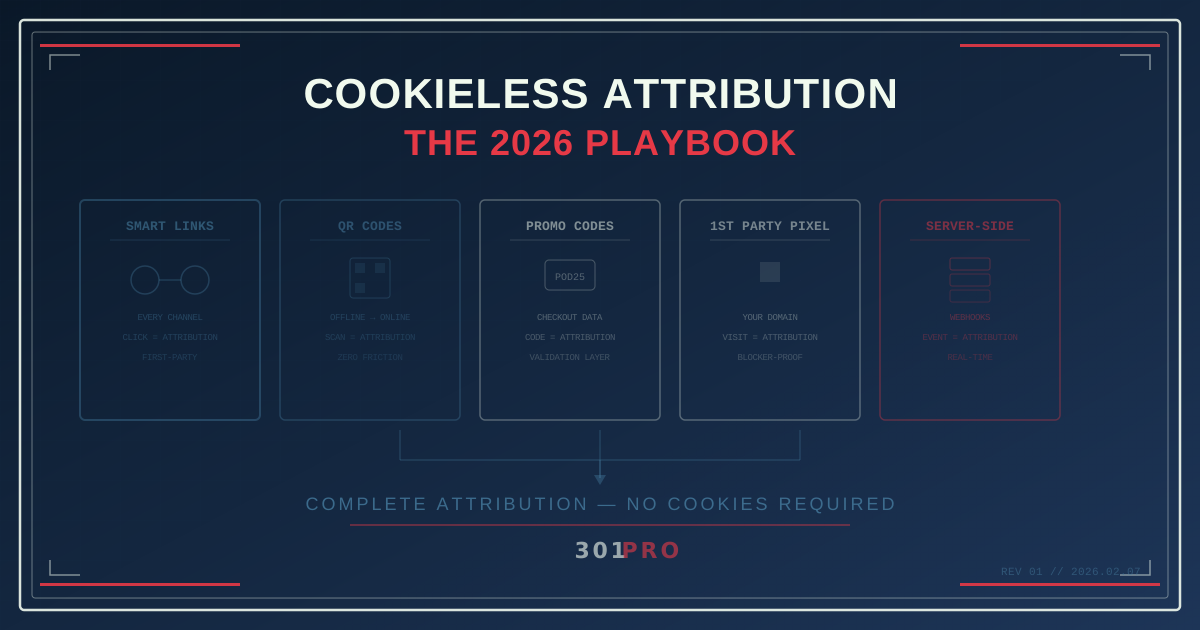
The Attribution Stack Got Demolished
If you built your marketing attribution model before 2024, most of it is broken now. Third-party cookies are gone from every browser. Apple’s ATT neutered cross-app tracking. Link Tracking Protection strips UTM parameters. Ad blockers kill tracking pixels for roughly 30-40% of desktop users in Western markets.
The old model was simple: cookies follow the user everywhere, ad platforms report everything, and your attribution dashboard stitches it together. That model is dead.
But attribution isn’t dead. It just changed shape. The 2026 attribution stack looks completely different from the 2020 version — and honestly, it’s better. Less creepy, more accurate, and built on signals that users can’t (and wouldn’t want to) block.
Here’s the complete playbook.
The Five Pillars of Cookieless Attribution
1. Smart Link Attribution
Every click on a link you control is an attribution event. No cookies required.
When someone clicks a 301.Pro smart link, the redirect captures source, device, location, and time — all first-party data from an intentional user action. Use distinct links per channel, and attribution is built into the link structure itself:
| Channel | Link | What You Learn |
|---|---|---|
| Email newsletter | 301.pro/cde/spring-email | Email-attributed clicks |
| Instagram bio | 301.pro/cde/spring-ig | Social-attributed clicks |
| Podcast ad read | 301.pro/cde/spring-pod | Audio-attributed clicks |
| SMS campaign | 301.pro/cde/spring-sms | SMS-attributed clicks |
| Direct mail QR | 301.pro/cde/spring-dm | Offline-attributed clicks |
Same destination. Different links. Automatic attribution at click time. This works for every digital channel and — critically — for offline channels too.
Best for: Cross-channel campaign measurement, offline-to-online attribution, any scenario where users click a link.
2. QR Code Attribution
QR codes are the only tracking technology that works in the physical world without requiring an app, an account, or any prior relationship with the user.
A QR code on a direct mail piece, a product package, a billboard, or a conference badge is an attribution event. When someone scans it, you capture location, device, time, and (via the smart link behind the code) channel source.
What makes QR attribution powerful in 2026:
- Zero friction — point camera, scan, done
- Location data — you know where the scan happened, not just which code was scanned
- Time data — when does your audience engage with physical materials?
- No cookies, no pixels, no JavaScript — the scan is the attribution event
Best for: Retail, events, direct mail, out-of-home advertising, product packaging, any physical-to-digital conversion.
3. Promo Code Attribution
The oldest attribution method in marketing still works — and in a cookieless world, it’s more valuable than ever.
A unique promo code per channel tells you exactly where the customer came from:
| Code | Channel | Discount |
|---|---|---|
| PODCAST25 | Podcast ad | 25% off |
| INSTA15 | 15% off | |
| MAILER10 | Direct mail | 10% off |
| EVENT20 | Conference | 20% off |
When a customer uses PODCAST25 at checkout, attribution is immediate and unambiguous. No tracking technology involved. No privacy concerns. The customer voluntarily provided the code.
Promo codes have limitations — they require the customer to remember and enter a code, and they can be shared beyond the intended channel. But they provide rock-solid attribution for the customers who do use them.
Best for: E-commerce, subscription services, anywhere you have a checkout or signup flow that accepts codes.
4. First-Party Pixel Attribution
First-party pixels — tracking scripts served from your own domain — survive ad blockers, privacy settings, and browser restrictions that kill third-party pixels.
While third-party pixels (Facebook Pixel, Google Analytics via analytics.google.com) get blocked by 30-40% of desktop browsers, first-party pixels load from yoursite.com and are treated as normal page resources.
301.Pro’s First Party Pixel connects the click (from pillar 1) to the on-site journey. User clicks a smart link → lands on your site → first-party pixel fires → click and visit are connected. Full attribution chain, no third-party anything.
Best for: Connecting click-level attribution to on-site behavior and conversions.
5. Server-Side Event Tracking
For the highest-value attribution events (purchases, signups, demo requests), server-side tracking eliminates every client-side limitation.
Instead of relying on a pixel in the user’s browser to report the conversion, your server sends the event directly to your analytics platform. Browser settings, ad blockers, and privacy extensions can’t intercept server-to-server communication.
With 301.Pro’s Real-Time Webhooks, click events fire server-side in real time. Your CRM receives the click event, matches it to a customer record, and when that customer converts, the attribution loop closes — entirely server-side.
Best for: High-value conversions, CRM integration, and scenarios where client-side tracking is unreliable.
Putting It Together: The 2026 Attribution Framework
No single pillar replaces everything cookies did. The power is in combining them:
Layer 1: Link-Level Attribution (Every Channel)
Every marketing touchpoint gets a unique smart link. This is your foundation — the broadest attribution layer that works across every channel including offline.
Layer 2: First-Party Pixels (On-Site)
Connect link clicks to on-site behavior. The pixel tells you what happened after the click: page views, engagement, form fills, and product views.
Layer 3: Server-Side Events (Conversions)
Capture high-value events server-side. Purchases, signups, and demo requests are too important to rely on client-side pixels. Real-time webhooks ensure these events are captured reliably.
Layer 4: Promo Codes (Validation)
Use channel-specific promo codes as a validation layer. If link attribution says 30% of conversions came from the podcast, and the PODCAST25 promo code was used by 28% of new customers, your link attribution is confirmed.
Layer 5: QR Codes (Offline Bridge)
For any physical touchpoint, QR codes provide the attribution link between offline exposure and digital engagement. Without them, offline campaigns are a measurement black hole.
What This Looks Like in Practice
Scenario: Multi-Channel Product Launch
You’re launching a new product across seven channels. Here’s how each gets attributed:
| Channel | Attribution Method | Signal |
|---|---|---|
Smart link (/cde/launch-email) | Click at redirect | |
| Paid social | Smart link (/cde/launch-meta) | Click at redirect |
| Podcast | Smart link + promo code | Click + POD20 at checkout |
| Influencer | Smart link (/cde/launch-creator) | Click at redirect |
| Direct mail | QR code (/cde/launch-mailer) | Scan at redirect |
| Retail display | QR code (/cde/launch-retail) | Scan at redirect |
| SMS | Smart link with Click Truth | Click + recipient identification |
First-party pixels on the landing page connect clicks to engagement. Server-side webhooks capture purchases. Promo codes validate channel attribution.
Total cost of this attribution framework: the price of your 301.Pro plan. No additional analytics tools needed for the core attribution layer.
Scenario: Measuring an Event Sponsorship
You sponsored a conference booth. How do you measure ROI when there are no cookies at a conference?
- Badge QR code: Branded QR code on your booth display → smart link → post-event follow-up page
- Business card links: Unique short link on each team member’s card → tracks which conversations led to engagement
- Session QR code: If you’re presenting, QR code in slides → measures audience engagement post-talk
- Follow-up email: Smart link in the post-event email → measures continued interest
Every touchpoint is attributed. Every scan and click is captured. The ROI calculation uses real data, not “we felt like the conference was worth it.”
The Data You Actually Get
Here’s what a cookieless attribution dashboard looks like in 2026:
| Metric | Source | Cookieless? |
|---|---|---|
| Channel attribution | Smart link clicks | Yes |
| Geographic breakdown | IP geolocation at click | Yes |
| Device split | User agent at click | Yes |
| Time-of-day patterns | Click timestamps | Yes |
| On-site engagement | First-party pixel | Yes |
| Conversion events | Server-side webhooks | Yes |
| Offline-to-online | QR code scans | Yes |
| Channel validation | Promo code usage | Yes |
| Bot filtering | Multi-signal detection | Yes |
Every row is cookieless. Every row is first-party. Every row survives ad blockers, privacy browsers, and iOS restrictions.
What You Lose (For Real This Time)
Cookieless attribution doesn’t replace everything. Here’s what’s actually gone:
- View-through attribution: You can’t measure “saw an ad but didn’t click.” This was always fuzzy, but it’s truly gone now.
- Cross-site user journeys: You can’t track someone from your blog to a review site to your pricing page to checkout across different domains.
- Passive audience building: You can’t silently build retargeting audiences from browsing behavior.
What remains is attribution based on intentional actions: clicks, scans, code entries, and form submissions. These are stronger signals anyway — someone who clicked is more valuable than someone who might have seen a banner.
The Practical Checklist for 2026
-
Set up distinct smart links per channel. This is step one. If you do nothing else, do this. Automatic attribution at click time.
-
Deploy first-party pixels on key pages. Landing pages, pricing pages, checkout pages. Connect clicks to engagement.
-
Create channel-specific promo codes. Even if the discount is the same, unique codes per channel provide attribution data.
-
Add QR codes to every physical touchpoint. Direct mail, packaging, retail displays, event materials. Bridge the offline gap.
-
Configure server-side webhooks for conversions. Don’t rely on browser pixels for your most important events.
-
Enable bot filtering. Your attribution data is only as good as the traffic quality feeding it. Filter bots before they enter your analytics.
-
Re-baseline your metrics. Your numbers will change. Probably significantly. That’s the old, inaccurate baseline being replaced by reality.
The Bottom Line
The cookie era trained marketers to expect passive, invisible tracking that followed users everywhere. That era is over, and no amount of clever engineering will bring it back.
The 2026 attribution model is built on active signals: clicks, scans, codes, and conversions. It requires more intentional setup but delivers more accurate data. And it works with privacy regulations instead of around them.
Set up the five pillars. Measure what people actually do. Stop mourning the cookies and start building something better.