Branded Short Links Get More Clicks — Here's the Data
← Back to Blog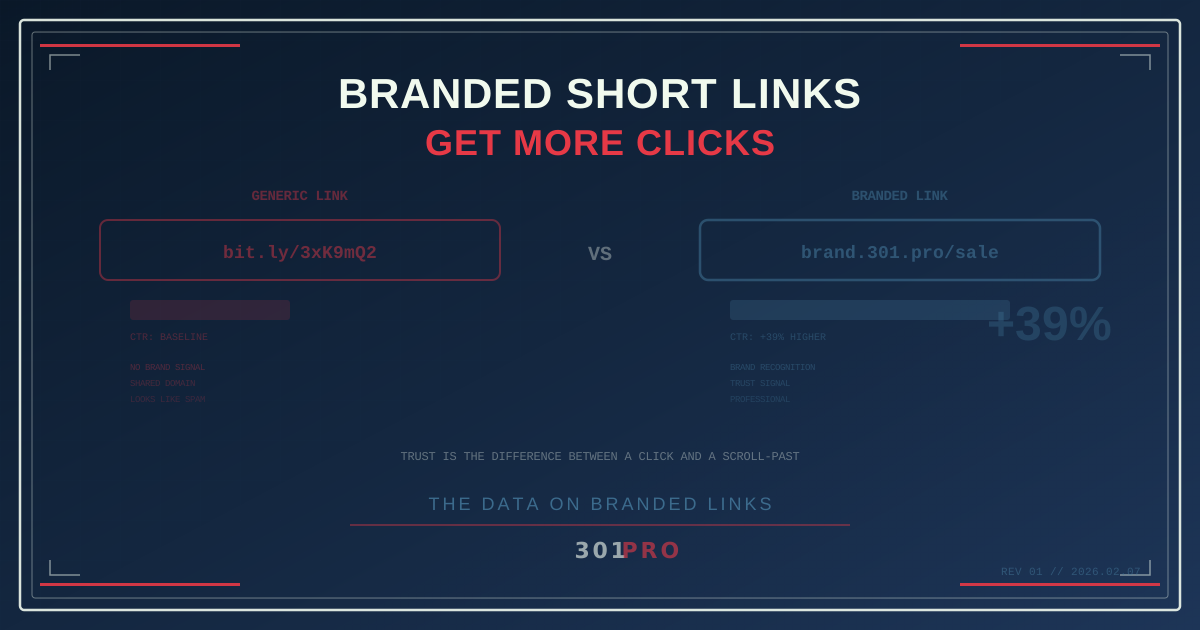
The Link People Won’t Click
You’ve composed the perfect social media post. The copy is sharp, the offer is compelling, the timing is right. Then you paste this at the end:
bit.ly/3xK9mQ2
Your audience sees the link and thinks: “Where does this go? Is this spam? Is this a phishing link? Do I trust this?”
Some people will click anyway. Many won’t. A generic short link tells the reader absolutely nothing about the destination. It’s a black box. And in 2026, people are trained to be suspicious of black boxes.
Now consider this alternative:
yourbrand.301.pro/spring
Same redirect. Same destination. Same analytics. But the reader can see the brand name in the URL. They know where this link comes from. Trust goes up. Hesitation goes down. Clicks go up.
The Data on Branded Links
The performance gap is measurable, and the vendors with the largest link datasets report it consistently. Bitly states that custom-domain (branded) links earn 2.3x more clicks on average than standard shortened links. Rebrandly’s own generic-vs-branded comparison reaches the same conclusion: for identical content, branded links draw a higher click-through rate. Directionally, the research lines up:
- Branded links see higher click-through rates compared to generic short links
- Recognition of the brand in the URL reduces perceived risk of clicking
- Branded links are more likely to be shared, extending organic reach
- On social media specifically, branded links see higher engagement across likes, shares, and comments
(Exact lift figures vary by vendor and methodology — treat the specific multipliers as directional, not guarantees.)
The lift varies by context. In SMS (where trust is paramount and smishing is rampant), the branded link advantage is even larger. In email marketing, branded links also help with deliverability since email security services are less likely to flag them.
Why Generic Links Hurt Performance
Generic short links have three problems that directly reduce click-through rates:
1. Zero Brand Signal
bit.ly/3xK9mQ2 contains no information about the destination. The reader can’t tell if this link goes to a product page, a blog post, a survey, or a phishing site. The random characters after the slash look like machine-generated noise.
Compare that to yourbrand.301.pro/spring-sale. The brand is visible. The destination is hinted at. The reader has context before they click.
2. Shared Domain Reputation
Generic shortener domains are used by millions of people for millions of purposes — including spam and phishing. When your marketing link uses the same domain as a scammer’s phishing link, your link inherits some of that negative association.
This isn’t just perception. Email filters, SMS carriers, and web browsers all maintain reputation scores for domains. Shared shortener domains have inconsistent reputations because they serve both legitimate and malicious content. Your perfectly legitimate marketing link gets dragged down by bad actors using the same domain.
3. No Memory
If someone sees your branded link once and had a good experience, they’ll recognize and trust it next time. yourbrand.301.pro becomes familiar. It’s your brand’s territory.
Nobody remembers bit.ly/3xK9mQ2. Every generic short link looks the same as every other generic short link. There’s no brand equity accumulation.
How Branded Links Work
Branded links use a custom subdomain or domain that includes your brand name. With 301.Pro, you can set up branded links in several ways:
Subdomain branding: yourbrand.301.pro/campaign-name
The branding appears before the domain, making the brand the first thing the reader sees. This is the fastest setup — you configure it in your 301.Pro dashboard and start using it immediately.
Custom domain branding: links.yourbrand.com/campaign-name
You use your own domain with a “links” subdomain. This puts your brand front and center with no third-party domain visible at all. It requires a DNS configuration (pointing your subdomain to 301.Pro’s servers) but offers the strongest brand signal.
In both cases, the short link functions identically to a generic one — same redirect, same analytics, same rules engine. The only difference is what the user sees.
Where Branded Links Matter Most
The branded link advantage isn’t uniform across all channels. Some contexts benefit more than others:
SMS Marketing
SMS is the highest-stakes channel for link trust. Smishing attacks have exploded, and recipients are increasingly wary of tapping links in text messages. A branded link in an SMS signals legitimacy in a way that a generic link simply can’t.
The CTR lift for branded links in SMS campaigns is consistently among the highest of any channel.
Social Media
Social media posts with branded links look more professional and trustworthy. The link itself becomes a brand touchpoint instead of a visual afterthought. On platforms where links are displayed as text (Twitter, LinkedIn posts), the brand name in the URL is immediately visible.
Print and Physical Media
QR codes encode URLs, and while users don’t see the URL directly in a QR code, they often see a printed URL alongside the code. yourbrand.301.pro/menu printed next to a QR code reinforces the brand and gives a fallback for manual entry.
Email Marketing
Branded links in emails serve a dual purpose: they build trust with the recipient AND they help with deliverability. Email security filters are more lenient with domains that have consistent, legitimate-only usage compared to shared shortener domains that serve millions of unknown users.
Internal Communications
Even inside your own organization, branded links look more professional in Slack messages, internal emails, and documentation. team.301.pro/handbook is immediately recognizable as an internal resource.
The Consistency Advantage
Beyond click-through rates, branded links provide a consistency advantage that compounds over time:
Brand recognition. Every time someone sees yourbrand.301.pro/something, they’re seeing your brand name. Across social posts, emails, SMS, print materials, and internal docs, that’s hundreds or thousands of brand impressions that generic links would waste.
Link trust accumulation. If you share a branded link to a great blog post, the next time someone sees a link with the same brand, they’re predisposed to click. Trust transfers from one link to the next because the domain is consistent.
Professional appearance. A Slack message with yourbrand.301.pro/q4-report looks more professional than one with bit.ly/3xK9mQ2. Small details, but they matter in professional contexts.
The Analytics Benefit
Branded links don’t change your analytics — they enhance them. When you look at your 301.Pro dashboard and see click data organized by branded links, you get a clearer picture of how your brand’s links perform across channels.
301.Pro’s Intelligent Bot Management works identically for branded and non-branded links. You still get:
- Human vs. bot traffic separation
- Device, geography, and timing data
- Conversion tracking
- Rules-based routing
The difference is that the link reaching the user carries your brand identity instead of a generic shortener’s.
Implementation
Setting up branded links with 301.Pro is straightforward:
- Choose your branding approach — subdomain on 301.pro or custom domain
- Configure the domain — in your 301.Pro dashboard (subdomain) or via DNS (custom domain)
- Create links — same process as always, but now they carry your brand
- Use them everywhere — replace generic short links across all channels
The transition from generic to branded links can be done gradually. Start with your highest-visibility channels (social media, SMS) where the trust signal matters most, then expand to other channels over time.
The Cost Question
Generic link shorteners are often free. Branded links require a professional link management platform. So is the branding worth the cost?
Consider: if branded links increase your click-through rate by even a modest amount, and your average campaign sends 10,000 links per month, even a few hundred additional clicks per month can change the ROI equation. If 5% of those additional clicks convert, the investment pays for itself quickly.
301.Pro’s professional plans start at $149/month. That’s the cost of a few additional conversions — and you’re also getting analytics, rules-based routing, bot filtering, and dynamic QR codes that generic shorteners don’t provide.
The Bottom Line
Generic short links are anonymous, untrustworthy, and forgettable. Branded short links are recognizable, trusted, and build equity over time.
The click-through data is clear: people click branded links more often because they trust them more. In a world where consumers are increasingly skeptical of unknown URLs, putting your brand name in every link you share isn’t vanity — it’s strategy.
Your brand worked hard to build recognition. Don’t hide it behind a random string of characters.