How Bot Traffic Makes Your Marketing Reports Useless (And What to Do)
← Back to Blog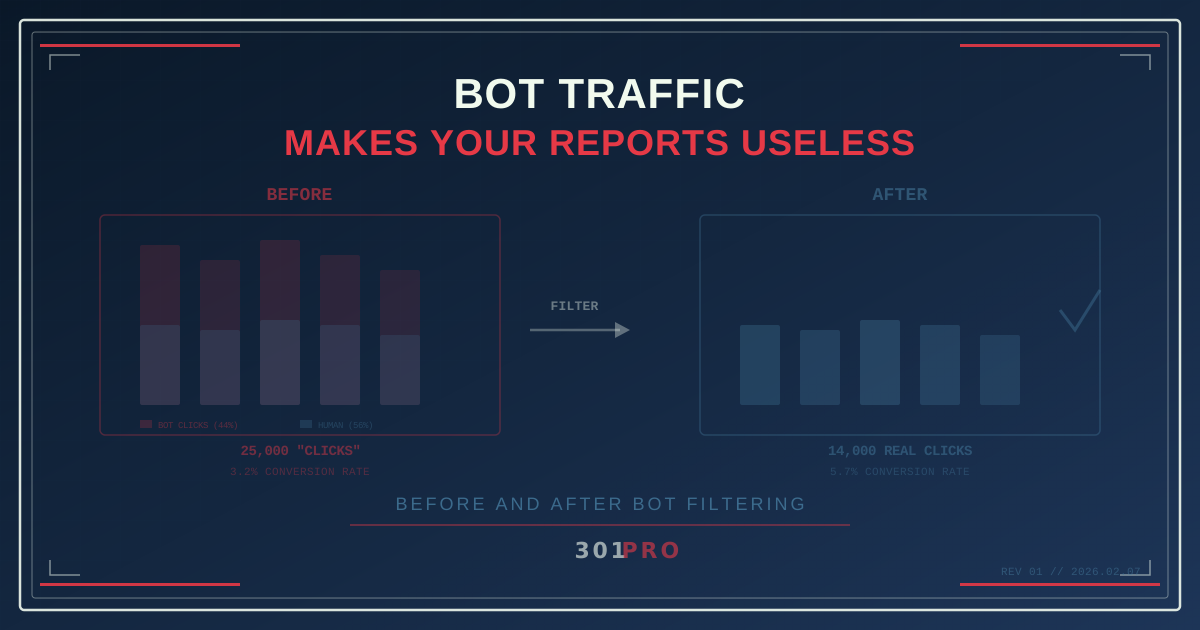
The Report That Doesn’t Add Up
You’re in the marketing review meeting. The dashboard says your latest campaign generated 25,000 link clicks. At $0.40 per click, that’s a $10,000 spend for 25,000 engagements. Looks solid.
But something doesn’t add up. 25,000 clicks, yet only 800 conversions. A 3.2% conversion rate. That seems low for a well-targeted campaign with a strong offer. Last quarter’s organic traffic converted at 5.8%.
Here’s the uncomfortable truth: your campaign probably didn’t get 25,000 clicks from real people. A significant portion of those clicks were bots — email security scanners pre-checking your links, scraper bots following every URL they encounter, and automated crawlers that have nothing to do with your target audience.
Strip those out, and your real human click count might be closer to 14,000. Your actual conversion rate jumps to 5.7% — right in line with your historical benchmarks. The campaign was performing fine. Your data was lying.
The Before/After Reality Check
Here’s what bot-contaminated analytics look like compared to clean analytics for the same campaign:
Before: Raw Click Data
| Metric | Value |
|---|---|
| Total clicks | 25,000 |
| Cost per click | $0.40 |
| Conversions | 800 |
| Conversion rate | 3.2% |
| Cost per conversion | $12.50 |
| Campaign verdict | ”Underperforming” |
After: Bot-Filtered Click Data
| Metric | Value |
|---|---|
| Human clicks | 14,000 |
| Bot clicks (removed) | 11,000 (44%) |
| Effective cost per click | $0.71 |
| Conversions | 800 |
| Conversion rate | 5.7% |
| Cost per conversion | $12.50 |
| Campaign verdict | ”On target” |
The conversions and total spend don’t change. But the story changes completely. In the raw data, the campaign looks like it’s converting poorly — you’d optimize against it, maybe cut the budget. In the clean data, you see a healthy conversion rate from genuinely engaged humans. The campaign is performing. You just had noise in the denominator.
Where the Bots Come From
Different marketing channels attract different types of bots at different rates:
Email Campaigns
Email is the worst offender. Enterprise email security services — Microsoft Safe Links, Proofpoint, Mimecast, Barracuda — pre-scan every link in every email before the recipient sees it. When your marketing email lands in 50,000 inboxes, thousands of security bots click your links within seconds.
Typical bot rate for email campaigns: 30-60% of all clicks.
This is why your email “click-through rates” look suspiciously high. A 35% click rate on a promotional email doesn’t mean 35% of recipients were interested. It means security bots clicked every link in the email for every recipient behind a corporate email gateway.
SMS Campaigns
SMS pre-scanners are less aggressive than email scanners, but they exist. Carriers and device-level security apps check links in incoming texts. Plus, if your SMS contains a link that gets shared or posted elsewhere, web crawlers find and follow it.
Typical bot rate for SMS campaigns: 15-35% of all clicks.
Social Media Links
Links shared on social platforms get crawled by the platform’s own preview bots, plus search engine crawlers that index social content, plus scraper bots that monitor social feeds.
Typical bot rate for social links: 20-40% of all clicks.
QR Code Scans
QR codes have the lowest bot rate because physical scanning is inherently human. But even QR campaigns aren’t immune — if the destination URL gets indexed or shared, bots will follow.
Typical bot rate for QR code campaigns: 5-10% of all clicks.
The Cascading Effect on Decisions
Bot-contaminated data doesn’t just inflate one metric. It cascades through your entire analytics and decision-making process:
Budget Allocation
If Channel A shows 50,000 clicks and Channel B shows 20,000 clicks, you’d naturally allocate more budget to Channel A. But what if Channel A has a 45% bot rate and Channel B has a 10% bot rate? Real human clicks are 27,500 vs. 18,000 — still favoring A, but the gap is much smaller. Maybe B deserves more budget than raw numbers suggest.
A/B Testing
You’re testing two landing pages. Page A gets 5,000 clicks and 200 conversions (4% rate). Page B gets 4,000 clicks and 200 conversions (5% rate). You declare B the winner.
But what if Page A’s link was shared on a platform with heavy bot traffic, inflating its clicks? What if Page A’s real human clicks were 3,000, giving it a 6.7% conversion rate? Now A is the winner. Bots just flipped your test result.
Attribution
Multi-touch attribution models assign credit to channels based on click volume. If bots inflate the clicks on certain channels disproportionately, those channels get undeserved credit, which distorts future planning and budget allocation.
Benchmarking
If you’re benchmarking your performance against industry averages, and industry averages include bot traffic, everyone’s working from inflated numbers. Your “underperformance” might be because you’re comparing bot-inflated industry benchmarks against your own bot-inflated (but differently inflated) data.
What Clean Analytics Look Like
301.Pro’s Intelligent Bot Management is built specifically for this problem. Instead of counting every HTTP request as a “click” and hoping for the best, it classifies every interaction:
Human clicks — verified as real browser-based interactions from actual devices. These are the numbers you make decisions on.
Bot clicks — classified by type (security scanner, crawler, scraper, fraud) and tracked separately. You can see them if you want, but they don’t contaminate your campaign metrics.
Suspicious clicks — interactions that show bot-like patterns but aren’t definitively classified. Flagged for review rather than counted as either human or bot.
The result is a dashboard where the numbers mean what they say. 14,000 clicks means 14,000 humans engaged with your content. Not 25,000 interactions, 44% of which were automated systems doing their thing.
The Report Fix
Here’s how to fix your marketing reports:
Step 1: Acknowledge the Problem
The first step is accepting that your current click numbers are inflated. This isn’t a failure — it’s how the internet works. Every marketing team deals with bot traffic. The ones making good decisions are the ones that filter it out.
Step 2: Establish a Clean Baseline
Run your campaigns through a platform with bot filtering for one quarter. Compare the clean data against your historical raw data. You’ll see the gap. This gives you a correction factor for historical comparisons.
Step 3: Report Clean Numbers
Present bot-filtered metrics as your primary data. You can show the raw numbers for context (“25,000 total interactions, 14,000 verified human clicks”), but let the clean numbers drive decisions.
Step 4: Recalibrate Your Benchmarks
Your “normal” click-through rates, conversion rates, and cost-per-click numbers will shift when you remove bots. This is a good thing. You’re now working with accurate benchmarks that will stay consistent over time instead of fluctuating with bot traffic patterns.
Step 5: Evaluate Channel Mix
With clean data, re-evaluate your channel allocation. Some channels will look better than they did under raw data (QR campaigns with low bot rates). Others will look worse (email campaigns with high bot rates). Adjust accordingly.
Why Most Platforms Don’t Filter
Here’s the cynical truth: many link shorteners and analytics platforms don’t filter bot traffic because higher numbers look better. A dashboard that shows 25,000 clicks is more impressive than one that shows 14,000. It feels better. It makes their platform look more valuable.
But impressive-looking numbers that lead to bad decisions aren’t actually valuable. They’re expensive fiction.
301.Pro’s approach is intentionally honest. We’d rather show you 14,000 real clicks and help you make good decisions than show you 25,000 inflated clicks and let you discover the truth when your conversion targets don’t materialize.
The Bottom Line
Your marketing reports are only as good as the data behind them. If bot traffic accounts for 30-50% of your click data — and for most campaigns, it does — then every metric derived from that data is wrong. Your click-through rates are wrong. Your conversion rates are wrong. Your cost-per-click is wrong. Your channel attribution is wrong.
The fix isn’t complicated: use analytics that separate humans from bots. 301.Pro’s Intelligent Bot Management does this automatically for every link. You get clean data, accurate reports, and decisions that are grounded in reality instead of noise.
The best marketing report isn’t the one with the highest numbers. It’s the one with the right numbers.