Why Your Bitly Links Might Be Hurting Your SEO (and You Don't Even Know It)
← Back to Blog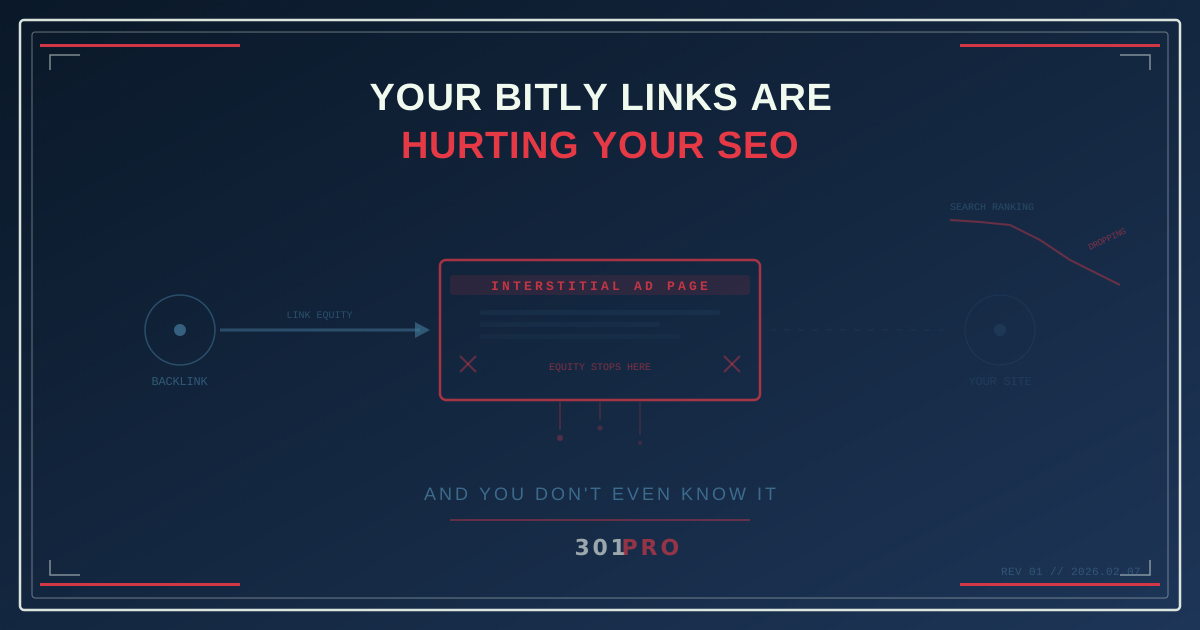
Your Links Are Leaking
Imagine you’ve been building a dam for years. Carefully placing each stone, each brick — backlink by backlink — to hold back a reservoir of SEO authority. Then one day, someone drills a hole in the wall. Not a big one. Just enough that the water starts seeping out.
That’s what’s happening to your Bitly links right now, and most people have no idea.
The 301 Redirect: SEO’s Best Friend
Let’s talk about how link equity (sometimes called “link juice” — yes, that’s the real term) actually flows through the internet.
When a search engine crawler follows a link, it looks at the HTTP response code to decide what to do:
| Redirect Type | What It Tells Google | Link Equity Passed? |
|---|---|---|
| 301 Redirect | ”This page has permanently moved here” | Yes — nearly 100% |
| 302 Redirect | ”This page is temporarily somewhere else” | Partial — Google may or may not pass it |
| JavaScript redirect | ”Run this code and go somewhere” | Unreliable — crawlers may not execute it |
| Interstitial page | ”Here’s a page… with a link to click” | Zero — it’s a new page, not a redirect |
A proper 301 redirect is like a sealed pipe — the SEO value flows directly from source to destination. It’s clean. It’s fast. It’s what search engines expect.
What Bitly Is Actually Doing
Here’s where it gets ugly. If you’re on Bitly’s free plan, your links no longer perform a clean 301 redirect. Instead, they do this:
- User clicks your
bit.ly/xyzlink - Bitly serves a full HTML page — their interstitial ad
- User sees the ad, maybe clicks “Continue”
- User finally arrives at your destination
From Google’s perspective, that interstitial page is a brand new document. It’s not a redirect. It’s a Bitly-owned web page that happens to link to your site. Your backlink equity doesn’t pass through a web page — it stops there.
The Silent Damage
This isn’t theoretical. If you’ve been using Bitly links in any of these places, your SEO might be taking hits:
Guest Posts & PR
You landed a guest post on a big industry blog. The author bio links back to your site through a Bitly URL. That link used to pass authority from the host domain to yours. Now? It passes authority to Bitly’s interstitial page.
Social Profiles
Your Twitter/X bio, LinkedIn profile, and Instagram link-in-bio all use Bitly URLs. While social links are mostly nofollow, some platforms do pass equity, and search engines use them as discovery signals.
Email Newsletters
Links in archived newsletters (many platforms make these publicly accessible) were passing link equity from the newsletter archive domain to your site. Not anymore.
Partner & Affiliate Links
If partners are linking to you through Bitly, the endorsement signal that used to flow to your domain now stops at Bitly’s ad page.
But Wait, It Gets Worse
It’s not just about losing the equity flow. There are secondary SEO effects:
Bounce Rate
Users who hit an unexpected ad page bounce. If your analytics are tracking that initial click, you’re seeing artificially high bounce rates on campaigns that should be performing well.
Page Speed Signals
Google considers page speed as a ranking factor for the entire user journey. An interstitial page adds 2-5 seconds of latency before users even see your content. That’s an eternity in web performance terms.
Core Web Vitals
Largest Contentful Paint, First Input Delay, Cumulative Layout Shift — all of these are measured from the user’s perspective. An ad page loading before your content destroys these metrics for click-through traffic.
Click Confidence
Users who see an unexpected page between their click and your content are less likely to click the next Bitly link they see. This trains your audience to hesitate — or worse, to not click at all.
The Math That Should Scare You
Let’s say you have 500 backlinks through Bitly across the web. Guest posts, forums, social media, partner sites, press releases.
If even 100 of those were passing meaningful link equity before, and now zero of them are, that’s a significant authority loss. In competitive niches, the difference between positions #3 and #8 on Google can be 20-30 authority points. You might have just given those away.
How To Audit the Damage
Here’s a quick checklist:
- Export your Bitly links — Go to your Bitly dashboard and download your link history
- Identify high-value sources — Which links are placed on domains with high authority? Guest posts, press coverage, partner sites
- Check the redirect chain — Use a tool like Redirect Checker or
curl -Ito see what HTTP response each link returns - Prioritize replacement — Start with the links on the highest-authority domains
# Quick check on any Bitly link
curl -sI "https://bit.ly/your-link" | grep -i "location\|HTTP"
If you see an HTTP 200 (meaning it’s serving a page) instead of a 301 (meaning it’s redirecting), that link is serving the interstitial.
The Fix
The cleanest solution: migrate your links to a platform that does proper 301 redirects. Always. Without exception.
At 301.Pro — and yes, it’s literally in our name — every link redirect is a true 301. No interstitial pages. No ad walls. No JavaScript redirects. Just a clean, standards-compliant permanent redirect that passes link equity the way search engines expect.
Here’s what a migration looks like:
- Import your Bitly links — We support bulk import
- Get matching short URLs — Your existing paths can be preserved
- Update what you can — Swap out Bitly URLs in places you control (social bios, your own site, email templates)
- Accept what you can’t — Guest posts on other sites may keep the old Bitly URLs, but at least new links will work properly
The Bigger Lesson
Your link shortener isn’t just a convenience tool — it’s part of your SEO infrastructure. Every redirect your links perform is a signal to search engines. Make sure that signal says what you want it to say.
A 301 redirect says: “This content lives here. Trust it. Pass the authority.”
An interstitial ad page says: “Here’s an ad. Maybe the user will eventually get where they wanted to go.”
Which one sounds like a better SEO strategy?