AI and Link Management: What's Real, What's Hype, and What's Coming
← Back to Blog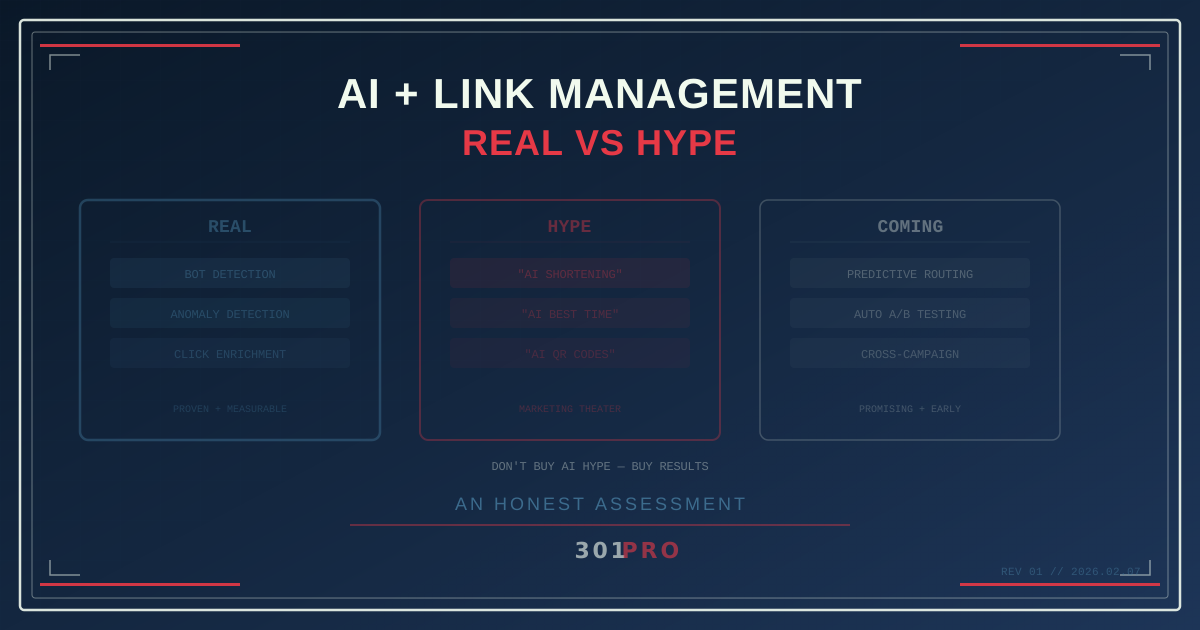
The AI Buzzword Problem
Open any SaaS product page in 2026 and you’ll find the words “AI-powered” within ten seconds. Email marketing? AI-powered. CRM? AI-powered. Project management? Definitely AI-powered. The kitchen sink? Probably AI-powered too.
Link management is no exception. Every platform wants to claim AI capabilities. But when you dig past the marketing copy, the reality is nuanced. Some AI applications in link management are genuinely transformative. Some are dressed-up automation wearing an AI hat. And some promising applications are still in early stages.
Here’s an honest assessment — no hype, no hand-waving.
What’s Real Right Now
Bot Detection and Filtering
This is the most mature and genuinely valuable AI application in link management. Machine learning models that distinguish human clicks from bot clicks are real, they work, and they solve a significant problem.
The challenge: between 30-50% of all link clicks come from automated sources. Link preview bots, security scanners, search crawlers, and malicious bots all generate clicks that look like human engagement. Traditional rule-based filters catch some of these, but sophisticated bots adapt to avoid simple rules.
Modern bot detection uses behavioral analysis — examining click patterns, timing, header information, and interaction sequences that distinguish human behavior from automated behavior. This isn’t marketing buzzword AI. It’s practical machine learning that produces measurably better analytics.
301.Pro’s Intelligent Bot Management is a concrete example: it identifies and separates bot traffic from human traffic, giving marketers analytics they can actually trust. This is AI that delivers immediate, tangible value.
Anomaly Detection
AI-powered anomaly detection monitors your link performance for unusual patterns and alerts you when something looks wrong:
- Traffic spike detection: Is this a legitimate viral moment or a bot attack?
- Geographic anomalies: Sudden traffic from an unexpected region might indicate a security issue
- Click pattern changes: A link that usually gets 100 clicks/day suddenly getting 10,000 deserves investigation
- Broken destination detection: Identifying when a destination URL starts returning errors before users report it
This is straightforward machine learning — establish a baseline, flag deviations. It’s not glamorous, but it prevents real problems from going unnoticed.
Click Data Enrichment
Enriching raw click data with contextual information — device identification, geographic precision, referrer classification — involves AI-adjacent techniques like device fingerprinting and IP geolocation. The “AI” here is pattern matching and classification, and it works well.
301.Pro’s Click Data Enrichment captures device type, geography, timing, and referrer data for every click. This enriched data powers better marketing decisions without requiring marketers to manually analyze raw server logs.
What’s Promising but Early
Predictive Routing
The idea: instead of routing links based on static rules (if location = Miami, then destination = Miami page), use AI to predict which destination will convert best for each individual click.
The concept is sound. If you have enough data, you could theoretically build models that predict: “A mobile user in Dallas clicking at 8 PM on a Tuesday is most likely to convert on landing page variant B.” Then route them there automatically.
The reality: this requires enormous data volumes to work well. Most individual links don’t generate enough clicks to train meaningful predictive models. At the campaign level, you might have enough data — but the models need to be retrained frequently as user behavior changes.
This is genuinely promising technology, but it’s not ready to replace human-configured routing rules for most use cases. The smart play is using AI predictions as suggestions that humans can approve or override, not fully autonomous routing.
Automated A/B Testing
Traditional A/B testing requires human setup: define variants, set traffic splits, determine success metrics, wait for statistical significance, and make a decision. AI can potentially automate parts of this:
- Multi-armed bandit algorithms that automatically shift traffic toward better-performing variants instead of waiting for a test to “finish”
- Automated variant generation where AI suggests landing page variations to test
- Dynamic significance calculation that determines when enough data has been collected
Some of these capabilities exist today in limited form. The multi-armed bandit approach is well-understood and works. Automated variant generation is less mature — AI can suggest headline changes, but the suggestions need human review.
Content-Aware Link Suggestions
AI that analyzes the content surrounding a link and suggests optimal destinations, anchor text, or placement. For example: “This blog post mentions summer sales — consider linking to the summer promotion page.”
This is technically feasible but adds complexity that most teams don’t need. A marketing team that knows their content calendar can make these decisions faster than an AI system can suggest them.
What’s Hype
”AI-Powered Link Shortening”
Making a long URL short doesn’t benefit from AI. A hash function or a sequential counter works fine. If a platform claims AI is involved in the shortening process itself, be skeptical. There’s no machine learning needed to turn a URL into a shorter string.
”AI Predicts the Best Time to Share Your Link”
Some platforms claim AI can tell you when to share links for maximum engagement. The reality is simpler: your analytics already show when your audience is most active. A histogram of click timestamps by hour tells you the same thing a “predictive AI model” does — and it’s more transparent.
This doesn’t require AI. It requires a dashboard with a time-of-day chart.
”AI-Optimized QR Codes”
QR codes are standardized data encoding. There’s no AI optimization to be done on the encoding itself. If a platform claims “AI-optimized QR codes,” they might mean design suggestions (color, logo placement, error correction level) — which is a reasonable application — but the core QR code technology doesn’t benefit from AI.
”AI Link Security”
Claiming AI protects links from security threats is often overstated. Good security comes from fundamentals: HTTPS, domain validation, access controls, monitoring. AI can assist with threat detection (anomaly detection, as mentioned above), but the phrase “AI-powered security” is often marketing for standard security practices.
What’s Actually Coming
Looking ahead with intellectual honesty about what AI is likely to contribute to link management in the near term:
Better Bot Classification
Current bot detection is good but not perfect. As bots become more sophisticated, AI models will improve at distinguishing genuine human engagement from increasingly human-like automated traffic. This is an ongoing arms race where AI’s role will continue to grow.
Cross-Campaign Intelligence
AI that identifies patterns across multiple campaigns and links — not just within a single link’s analytics. “Your retail links perform 40% better when shared between 6-8 PM on weekdays” is the kind of cross-campaign insight that AI can surface from large datasets.
Predictive Link Decay
Predicting when a link’s engagement will decline and suggesting refreshes or destination updates before traffic drops. This is pattern recognition applied to link lifecycle data — straightforward and useful.
Natural Language Link Search
Finding the right link in a large library using natural language queries: “Show me the link we used for the Miami campaign last October.” This is a search and retrieval problem that modern language models handle well.
How to Evaluate AI Claims
When a link management platform (or any platform) claims AI capabilities, ask these questions:
-
What specific problem does the AI solve? If the answer is vague (“it makes everything better”), be skeptical.
-
What data does it use? AI needs data. If the platform can’t explain what data trains the model, the AI might not exist.
-
Can you turn it off? Good AI tools are transparent and optional. If you can’t see what the AI is doing or disable it, you can’t verify it works.
-
Does it improve over time? Real machine learning gets better with more data. If the “AI” performance is static, it’s probably just rules-based logic with an AI label.
-
What’s the alternative? Sometimes a simple rule does the job better than a complex model. AI should solve problems that rules can’t solve efficiently.
Our Honest Position
At 301.Pro, we use AI where it genuinely helps and skip it where it doesn’t:
- Bot detection: Real AI. Real value. Our Intelligent Bot Management uses machine learning to separate human clicks from automated traffic.
- Click Data Enrichment: Uses classification and pattern matching to enrich raw click data with useful context.
- Anomaly detection: Machine learning identifies unusual patterns in link performance.
- Rules engine: Not AI. It’s a rules engine. Rules are transparent, predictable, and reliable. We don’t pretend they’re AI.
- QR code generation: Not AI. It’s standard encoding. We don’t claim otherwise.
We’d rather be honest about what uses AI and what doesn’t than slap an “AI-powered” label on everything. Your trust matters more than our marketing copy.
The Bottom Line
AI in link management is neither the revolution that hype suggests nor the nothing that skeptics claim. It’s genuinely useful for specific problems — bot detection, anomaly detection, data enrichment — and overhyped for everything else.
The best link management platform isn’t the one with the most AI buzzwords. It’s the one that solves your actual problems, whether it uses machine learning or a simple if-then rule.
Don’t buy AI hype. Buy results.