301 vs. 302 Redirects: The Difference That's Quietly Killing Your SEO
← Back to Blog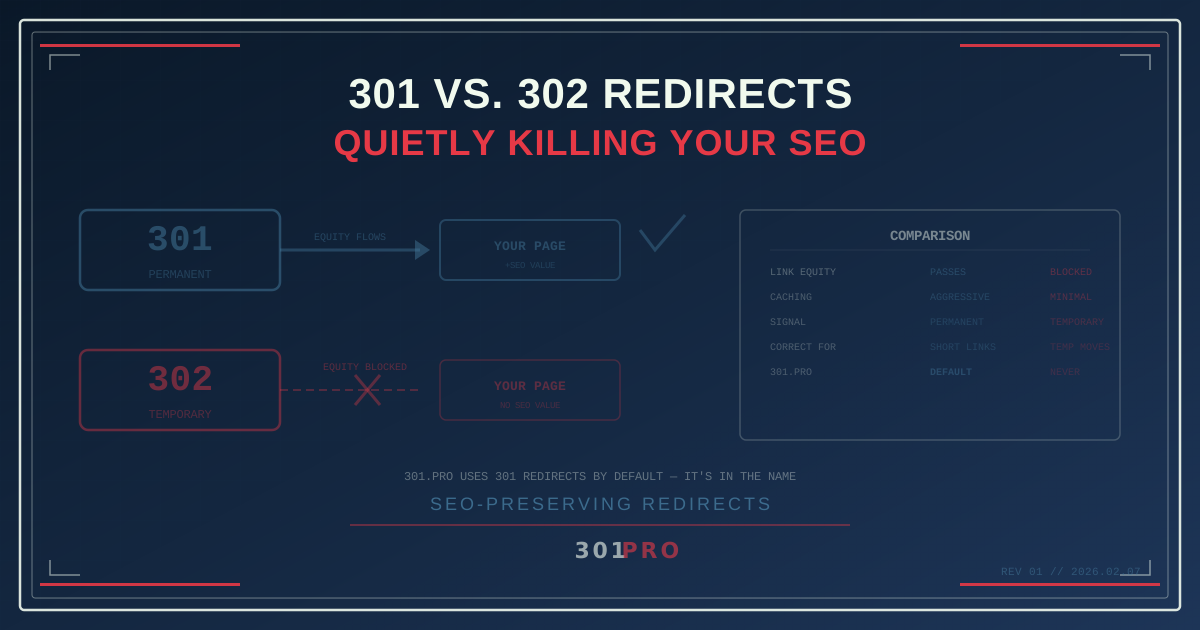
The Redirect Nobody Thinks About
Every time someone clicks a short link, a redirect happens. The browser hits the short URL, receives a redirect response, and follows it to the destination. This takes milliseconds. Nobody notices.
But Google notices. And the type of redirect — 301 or 302 — determines whether your destination page gets the SEO benefit of that link, or whether the benefit evaporates into nothing.
Most people using short links have no idea this is happening. They create a link, share it, and assume they’re building SEO value for their destination page. But if their link shortener uses 302 redirects (and many do), they’re leaving link equity on the table.
The Difference in Plain English
301 — Permanent Redirect
A 301 redirect tells search engines: “This URL has permanently moved to a new location. Transfer all the link equity, ranking signals, and authority to the new destination.”
When Google sees a 301 redirect from shortlink.com/abc to yourbrand.com/landing-page, it treats the destination as the canonical URL and passes the link equity through. If someone linked to your short URL on their blog, that link value flows to your landing page.
302 — Temporary Redirect
A 302 redirect tells search engines: “This URL is temporarily pointing somewhere else, but it might come back. Keep the authority on the original URL.”
When Google sees a 302 redirect from shortlink.com/abc to yourbrand.com/landing-page, it may keep the authority on the shortener’s URL instead of passing it to your destination. The link equity stays at the short link — which is on someone else’s domain.
That’s a significant difference. One passes the value to you. The other keeps it in limbo.
Why This Matters for Marketing Links
Every time your short link gets shared — in a blog post, on social media, in an email, in a document — it creates a potential link signal. If that link uses a 301 redirect, search engines can pass the equity to your destination page, helping it rank.
If it uses a 302, the equity may stay on the shortener’s domain. You get the click traffic but not the SEO value.
Consider the lifecycle of a marketing link:
- You create a short link for a campaign
- The link gets shared on social media, in email, in blog posts
- Some of those shares happen on indexed pages (blogs, forums, articles)
- Search engines crawl those pages and follow the links
- The redirect type determines where the equity goes
With 301 redirects: Equity flows to your landing page. Over time, external links pointing to your short URLs contribute to your destination’s domain authority and page rank.
With 302 redirects: Equity may stay on the shortener’s domain. Your landing page misses out on the cumulative SEO value of all those external links.
The “Temporary” Lie
Here’s the irony: most link shorteners use 302 redirects even though the link is permanent. When you create a short link that points to your product page, that redirect is about as permanent as redirects get. There’s nothing “temporary” about it.
Why do some shorteners use 302s? A few reasons:
- Caching. 301 redirects can be cached aggressively by browsers and intermediate proxies. Some shorteners use 302s to prevent caching so they can track every click.
- Flexibility. Some platforms argue that 302s give them flexibility to change destinations. But you can change destinations with 301s too — the browser just caches the redirect longer.
- Oversight. Some platforms simply defaulted to 302 and never changed it.
None of these reasons benefit you as the link creator. They benefit the shortener’s infrastructure at the expense of your SEO.
What 301.Pro Does (It’s in the Name)
301.Pro uses 301 redirects by default. It’s not subtle — we named the product after it.
When someone clicks a 301.Pro link, the redirect is a proper 301 Moved Permanently. Search engines that follow the link transfer equity to your destination page. You get the click tracking AND the SEO value.
We solve the caching concern differently. Instead of using a suboptimal redirect type to prevent caching, we use server-side click tracking that captures analytics before the redirect is issued. The redirect type doesn’t affect our ability to track clicks — it only affects whether your destination gets the SEO benefit.
Real-World Impact
The SEO impact of redirect type depends on how many external links point to your short URLs. For most individual campaign links, the impact is small. But it compounds:
Scenario: Active Blog
You write weekly blog posts and share them on social media, in newsletters, and in communities using short links. Over a year, that’s 52 short links shared across hundreds of placements. Some of those placements are on indexed pages — other blogs that reference your content, forum posts, curated lists.
With 301s: Each external mention passes equity to your blog posts. Your domain authority builds incrementally over the year.
With 302s: Those external mentions build equity on the shortener’s domain, not yours. Your blog posts miss out on hundreds of potential link signals.
Scenario: Product Pages
Your product team uses short links in press releases, partner materials, and review guides. A product review on a high-authority tech blog links to your short URL.
With 301: That high-authority backlink passes equity through to your product page. This is exactly the kind of link signal that moves rankings.
With 302: The link equity stays at the shortener. Your product page gets traffic from the review but not the SEO benefit.
Scenario: QR Codes
Your QR codes on packaging, signage, and print materials encode short links. Some of those QR codes get photographed and shared online, creating web-accessible links.
With 301: The growing web of QR code images and mentions builds equity for your destination pages.
With 302: Those mentions benefit the shortener’s domain.
The Counter-Argument
Some SEO professionals argue that Google has gotten better at treating 302s like 301s in many cases. That’s partially true — Google has stated that they try to pass link signals through 302s when they believe the redirect is effectively permanent.
But “try to” and “reliably do” are different things. Google’s behavior with 302s is:
- Inconsistent. Sometimes equity passes, sometimes it doesn’t. It depends on Google’s interpretation of the intent.
- Uncertain. You’re relying on Google to correctly guess that your 302 is actually permanent.
- Unnecessary. When you can just use a 301 and get guaranteed equity transfer, why rely on Google’s interpretation of a misused redirect type?
Using a 301 is the explicit, correct, guaranteed way to tell search engines to transfer link equity. Using a 302 and hoping Google treats it like a 301 is… hope-based SEO. Not a strategy.
Quick Reference
| Feature | 301 Redirect | 302 Redirect |
|---|---|---|
| Signal to search engines | ”Moved permanently" | "Moved temporarily” |
| Link equity transfer | Yes, reliably | Maybe, inconsistently |
| Browser caching | Aggressive (good for performance) | Minimal |
| Correct for short links | Yes | No |
| 301.Pro default | Yes | No |
What to Check
If you’re currently using a link shortener, here’s how to check what redirect type it uses:
Using curl:
curl -I https://your-short-link.com/abcLook for the HTTP/ response line. 301 Moved Permanently = good. 302 Found or 302 Moved Temporarily = equity leak.
Using browser dev tools:
- Open DevTools (F12)
- Go to the Network tab
- Click the short link
- Look at the first request’s status code
If your current shortener uses 302s, you’re leaving SEO value on the table for every link you’ve shared.
The Bottom Line
The redirect type of your short links is a small detail that compounds into a significant SEO factor over time. 301 redirects pass link equity to your destination. 302 redirects keep it on the shortener’s domain.
301.Pro uses 301 redirects because that’s the correct redirect type for permanent short links — which is what every marketing link is. We built the whole product around getting this fundamental right. It’s literally in the name.
If you’re going to the trouble of creating, sharing, and promoting links, make sure the SEO value actually reaches your destination.